Stronger knees can transform how you move every day—from climbing porch stairs with ease to rising smoothly from your favorite armchair. You do not need a gym membership or floor mats to rebuild reliable leg power after 60.
Gentle, targeted chair exercises for knees strengthen the muscles that shield your joints while keeping painful impact off sensitive cartilage. With one sturdy seat and a few quiet minutes, you can build lasting knee strength right at home.
Below, you will discover five trainer-approved seated moves, simple weekly targets, and clear safety rules to keep you moving with confidence.
Why Knee Strength Matters More After 60
Your knees carry an impressive workload every time you stand, walk, or step over a curb. Over time, normal wear and tear combine with natural muscle loss to make those everyday tasks feel heavier than they should.
Joint discomfort after 60 is remarkably common, and you are far from alone if your knees feel stiff in the morning. According to the World Health Organization, the knee is the joint most frequently affected by osteoarthritis, impacting 365 million people globally.
Around 73 percent of people living with osteoarthritis are older than 55, and 60 percent are women. In broader global estimates from the American College of Rheumatology and the American College of Sports Medicine, osteoarthritis affects more than 600 million people worldwide.
Closer to home, data from the Centers for Disease Control and Prevention show that 46.9 percent of U.S. adults aged 65 and older had diagnosed arthritis in 2025. Earlier age-specific survey numbers reported diagnosed arthritis in 44.0 percent of adults aged 65 to 74 and 53.9 percent of those 75 and older.
Symptomatic knee osteoarthritis affects roughly 13 percent of women and 10 percent of men aged 60 and up. Among U.S. adults with arthritis, 58.5 percent reported moderate to severe joint pain in 2023 survey data.
The Quiet Role of Age-Related Muscle Loss
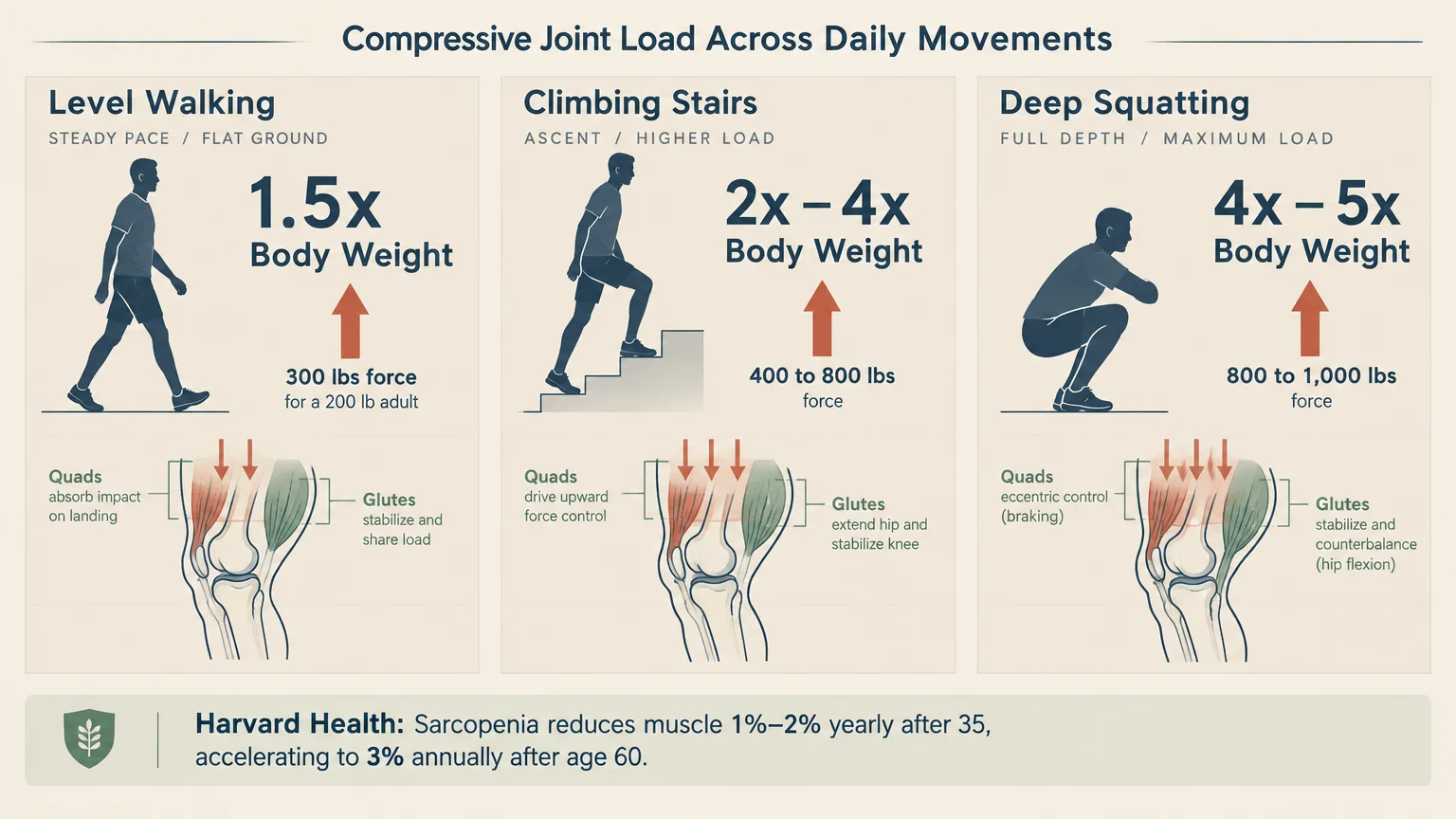
Joint cartilage often takes the blame for aching knees, yet weakened muscles usually drive the problem. Harvard Health notes that age-related muscle loss, known as sarcopenia, starts around age 35 at 1 to 2 percent per year.
Without regular strength work, that decline can speed up to 3 percent each year after age 60. When arthritis enters the picture, the American College of Sports Medicine reports an added 1 to 2 percent annual loss in leg strength and a 3.5 percent annual drop in leg power.
Think of your leg muscles as custom shock absorbers wrapped around each joint. Every step on level ground places force equal to 1.5 times your body weight across your knees—that equals 300 pounds of pressure per step for a 200-pound person.
Climbing or descending stairs multiplies that load to two to four times your body weight, while deep squatting pushes knee forces up to four or five times your weight. Strong thighs, hips, and glutes catch much of that force before bone and cartilage absorb the shock.
Building muscle does more than ease current stiffness; it protects your future mobility too. Muscle-strengthening exercise lowers your risk of developing joint pain and osteoarthritis later in life by 18 to 23 percent, according to the American College of Sports Medicine.
That protective payoff explains why the American College of Rheumatology strongly recommends exercise as a first-line treatment for knee osteoarthritis. Seated exercises for seniors deliver those strengthening benefits safely without pounding already tender joints.
Setting Up Your Chair for Safe, Effective Workouts
Before you lift a single foot, take 30 seconds to set up your space properly. Choosing the right seat prevents wobbling, improves posture, and gives your legs plenty of room to extend.
Following UK National Health Service sitting exercise guidance, pick a solid, stable chair without wheels and without armrests. Armrests can block your elbows or restrict your thighs during hip marches and outer-thigh presses.
Place the chair on a flat, nonslip surface such as a low-pile rug or bare floor. Sit toward the front half of the seat so your feet plant flat on the floor with your knees bent at crisp 90-degree angles.
If your feet dangle off the edge, slide back slightly or choose a lower seat. Should you later progress to standing-assisted exercises or heavier routines, the National Institute on Aging recommends keeping a sturdy chair with arms nearby for steady balance support.
Warming Up and Staying Hydrated
Cold muscles feel tight, and dry joints resist sudden movement. Take time to wake up your circulation before pushing into full-range holds.
The American Academy of Orthopaedic Surgeons suggests warming up with 5 to 10 minutes of gentle, low-impact movement such as easy walking. When you prefer to stay seated from start to finish, National Health Service seated programs use a brisk 30-second chair march to warm the hips and knees.
Keep a tall glass of water on a nearby table before you begin. The National Institute on Aging cautions that many older adults lose natural thirst cues, even when their muscles and joints actively need fluids during light workouts.
5 Easy Chair Exercises for Knees That Trainers Swear By
A complete knee-friendly routine works more than just the front of your thigh. The American Academy of Orthopaedic Surgeons knee conditioning guidelines target five interconnected areas: quadriceps, hamstrings, outer thigh abductors, inner thigh adductors, and glutes.
When all five muscle groups share the workload, your kneecap tracks smoothly in its groove instead of pulling to one side. Move at a slow, deliberate pace during every repetition, avoiding sudden or jerky swings as advised by the Royal Australian College of General Practitioners.
1. Seated Hip Marching
Seated hip marching wakes up your hip flexors, engages your core, and gently bends the knee through a comfortable arc. Trainers love starting here because it boosts blood flow around stiff joint capsules without putting weight on your feet.
Sit upright away from the backrest with your feet flat and hands resting lightly on the sides of the seat. Pull your belly button gently toward your spine to keep your lower back tall and supported.
Lift your right knee straight upward a few inches while keeping your knee bent, as if stepping over a low shoebox. Pause smoothly at the top for a breath, then lower your foot softly back to the floor.
Switch immediately to your left leg and alternate sides in a steady, controlled rhythm. Following National Health Service and Health Service Executive seated guidelines, start with 5 controlled lifts per leg and add more repetitions gradually as your stamina grows.
Watch your posture as you tire so you do not slump backward into the chair. Keep your shoulders relaxed away from your ears and breathe evenly throughout every march.
2. Seated Isometric Quad Squeezes
When aching knees make bending feel uncomfortable, isometric squeezes build strength without moving the joint at all. This gentle hold wakes up the quadriceps—the four muscles along the front of your thigh—while sparing irritated cartilage.
Sit near the front edge of your chair and slide your right heel forward until your leg is nearly straight, keeping a tiny softness at the knee if full extension pinches. Rest your left foot flat on the floor for solid balance.
Flex your right toes gently back toward your shin and tighten the muscle right above your kneecap. Imagine pressing the back of your knee slightly downward toward the floor without actually bending your torso forward.
Hold that firm thigh squeeze for 5 full seconds while breathing out steadily, then let the muscle relax completely. Based on clinical exercise guidance shared by WebMD, aim for 2 sets of 10 repetitions on each leg.
Never hold your breath during an isometric hold, because holding breath spikes blood pressure unnecessarily. Count out loud from one to five on every squeeze to guarantee smooth, steady breathing.
3. Seated Straight-Leg Extensions
Once isometric squeezes feel comfortable, seated straight-leg extensions challenge your quadriceps against gravity. Strong quads stabilize your knee whenever you step off a curb, lower into a car seat, or rise from bed.
Begin seated upright with both feet flat on the floor and knees bent at 90 degrees. Lightly grip the edges of your chair seat for torso stability without leaning back.
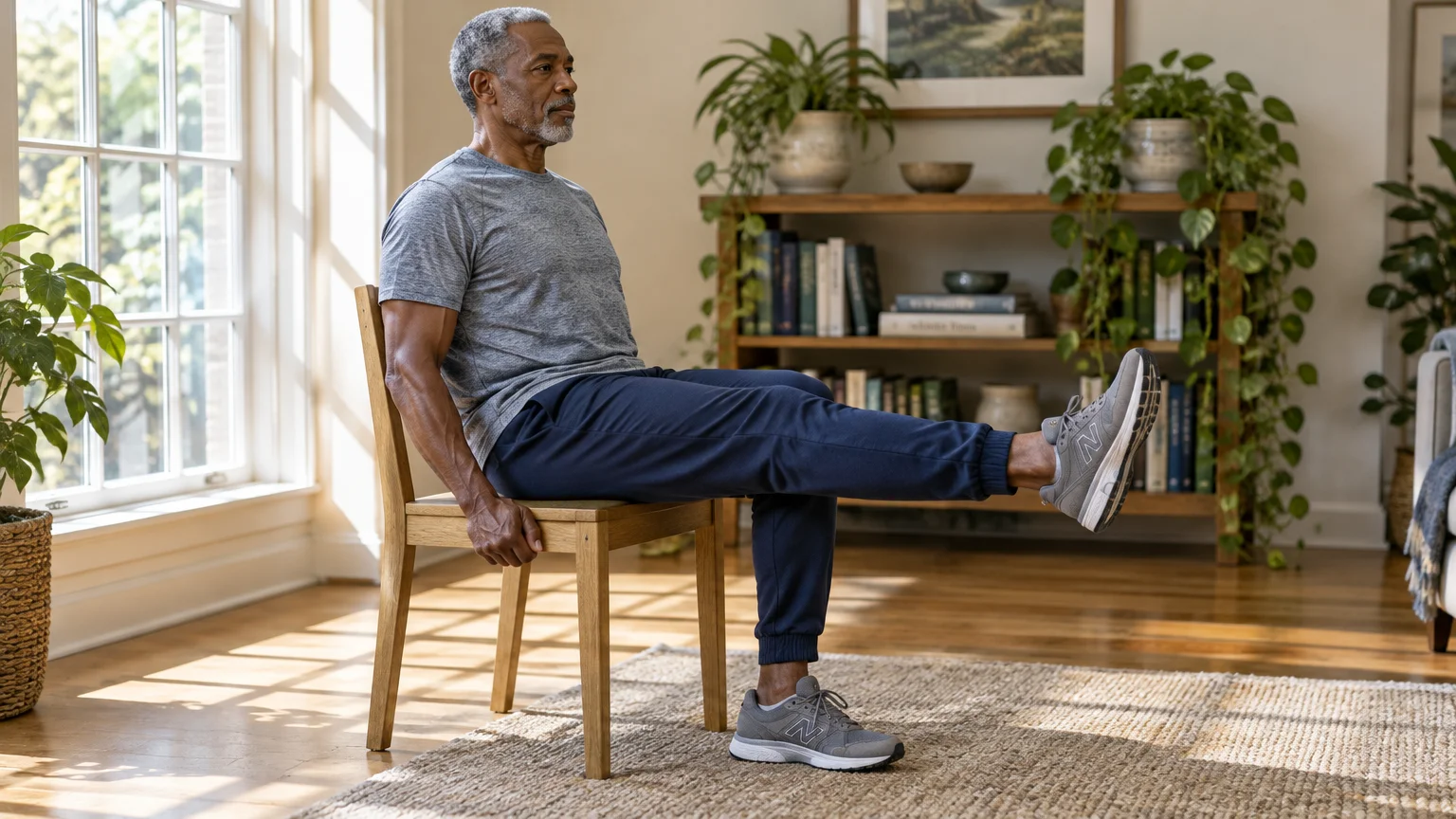
Slowly straighten your right leg out in front of you until your knee locks softly and your shin sits parallel to the floor. Point your toes gently toward the ceiling rather than letting your foot droop.
Following Arthritis UK guidance, hold your extended leg high for a slow count of 10 seconds, feeling the top of your thigh work steadily. Lower your foot back to the floor over three full seconds instead of letting gravity drop it.
Complete 10 slow repetitions on your right side before switching to your left leg. If 10 seconds feels shaky at first, start with a 3-second hold and add a second each week until you reach 10.
4. Seated Inner- and Outer-Thigh Presses
Weak hips let your knees wobble inward every time you take a step, twisting the joint awkwardly. Training both your inner thigh adductors and outer thigh abductors—alongside your glutes—creates side-to-side stability that keeps knee tracking clean.
For the inner-thigh press, place a folded bath towel or small firm sofa pillow squarely between your knees. Sit tall with feet flat on the floor and hands resting comfortably on your hips.
Squeeze your knees inward against the pillow steadily for 5 seconds, feeling your inner thighs tighten without lifting your heels. Release the pressure slowly and pause for two breaths before repeating 8 to 10 times.
Next, target your outer thighs and gluteus medius with no equipment at all. Place the palms of your hands firmly against the outside of each knee while keeping your feet hip-width apart.
Press your knees gently outward against your palms while using your arms to hold your legs still for 5 seconds. You should feel a firm engagement along the outside of your hips and upper glutes; complete 8 to 10 slow presses.
5. Seated Hamstring Heel Press and Stretch
Focusing only on the front of your legs creates an imbalance that tugs unevenly on your kneecap. Strengthening and lengthening your hamstrings—the muscles along the back of your thighs—protects the rear of the joint and makes walking strides feel effortless.
Sit close to the front edge of your chair and extend your right leg slightly forward with your heel planted firmly on the floor and toes pointing up. Keep a slight bend in that knee rather than locking it rigidly.
Press your right heel straight downward into the floor for 5 seconds as if trying to drag your heel backward toward the chair legs without actually sliding it. You will feel the back of your thigh fire smoothly; relax and repeat 8 to 10 times per leg.
Finish your session by stretching that same muscle group safely. Keep your right heel planted forward with toes pointed upward, place both hands lightly on your bent left thigh for support, and hinge forward slightly from your hips with a flat back.
Stop as soon as you feel a gentle stretch behind your right thigh—never force it into pain. Hold for 5 seconds twice per leg as used in National Health Service falls programs, or linger up to 20 seconds post-workout as suggested by WebMD.
The Hidden Payoff of Stronger Knees—and Signs You Need More Movement
Consistent knee exercises over 60 deliver rewards far beyond fewer morning aches. Stronger thighs and hips directly restore independence in daily tasks you might have started avoiding.
You will notice steadier footing on uneven pavement, smoother transitions getting in and out of low cars, and less reliance on stair handrails. Even better, staying active pairs powerfully with healthy weight habits.
Research cited by the Arthritis Foundation shows that every 1 pound of body weight lost removes roughly 4 pounds of pressure from your knees with every step. Losing just 5 pounds takes about 20 pounds of pressure off your knees with every step.
Signs Your Knees Are Asking for Strength Work
Muscle weakness creeps in quietly, often masquerading as simple aging. Watching for early warning signs helps you step in before stiffness limits your favorite activities.
Notice whether you push hard off armrests with both hands just to stand up from a dining chair. Pay attention if your knees feel stiff for 15 minutes after watching a movie, or if you hesitate before stepping off a sidewalk curb.
A subtle wobble when standing on one foot to pull on trousers also signals weak hip abductors and quadriceps. Those clues tell you your joints need muscular backup, not total bed rest.
Unfortunately, most older adults miss out on these protective gains because official exercise targets sound overwhelming. According to a federal Health and Human Services midcourse report, fewer than 15 percent of U.S. adults aged 65 and older meet full physical activity guidelines.
Among adults living with knee osteoarthritis specifically, a June 2026 meta-analysis found that only 13 percent reached 150 weekly minutes of moderate-to-vigorous activity in 10-minute bouts. Yet promising new science proves you do not need marathon workouts to turn things around.
A Penn State College of Medicine study published in PLOS One in October 2026 revealed that just 4 minutes a day of strength training significantly improved leg strength, balance, and chair-stand ability in adults 65 and older after 12 weeks. Separate research in Arthritis Care & Research, highlighted by Harvard Health, found that older adults with lower-limb osteoarthritis who completed 45 minutes per week of moderate activity were 80 percent more likely to improve walking speed and daily function.
How to Easily Add Seated Knee Exercises to Your Week
Building knee strength works best when movement blends naturally into the routines you already enjoy. Rather than rearranging your entire calendar, anchor these five exercises to daily habits you never skip.
Public health guidelines from the Centers for Disease Control and Prevention, the World Health Organization, and the National Health Service recommend at least 150 minutes per week of moderate aerobic activity for adults 65 and older. On a 10-point effort scale, moderate activity feels like a 5 or 6—hard enough that you can talk comfortably, though not sing.
Alongside aerobic movement, these agencies advise muscle-strengthening activities on 2 or more days each week plus balance-focused exercises like standing smoothly from a chair. For knee maintenance, the American Academy of Orthopaedic Surgeons recommends 2 to 3 strength days weekly following an initial 4- to 6-week conditioning phase.
The National Strength and Conditioning Association echoes that 2- to 3-day weekly rhythm, suggesting 2 to 3 sets per muscle group with 2 minutes of rest between sets. Importantly, their position statement notes that beginners gain comparable initial strength from just one single set.
Practical Ways to Stack Your Sessions
The Centers for Disease Control and Prevention confirms that adults with arthritis can split movement into 5- or 10-minute bursts and still earn full weekly benefits. Short sessions keep fatigue low and consistency high.
Try pairing Seated Hip Marches and Isometric Quad Squeezes with your morning kettle while waiting for tea or coffee to steep. Run through Straight-Leg Extensions and Thigh Presses during two commercial breaks while watching the evening news.
Finish with Seated Hamstring Heel Presses and gentle stretches right before putting on your evening slippers. Spreading exercises across the day eliminates dread and keeps joints lubricated from morning through night.
A simple weekly plan might look like strength work on Monday, Wednesday, and Friday mornings, taking roughly 10 to 12 minutes each session. On Tuesday, Thursday, and Saturday, enjoy a 20- to 30-minute walk at a conversational pace, leaving Sunday for light stretching and rest.
Progress patiently using a simple rule backed by the National Health Service and the Royal Australian College of General Practitioners. Stay at your starting repetition count until the final two reps feel smooth and manageable, then add one or two repetitions or one extra second to your hold.
When to Slow Down, Check Form, or Call a Professional
Knowing the difference between healthy muscle work and true joint warning signs keeps your routine safe month after month. Respecting your body’s feedback lets you stay consistent without setbacks.
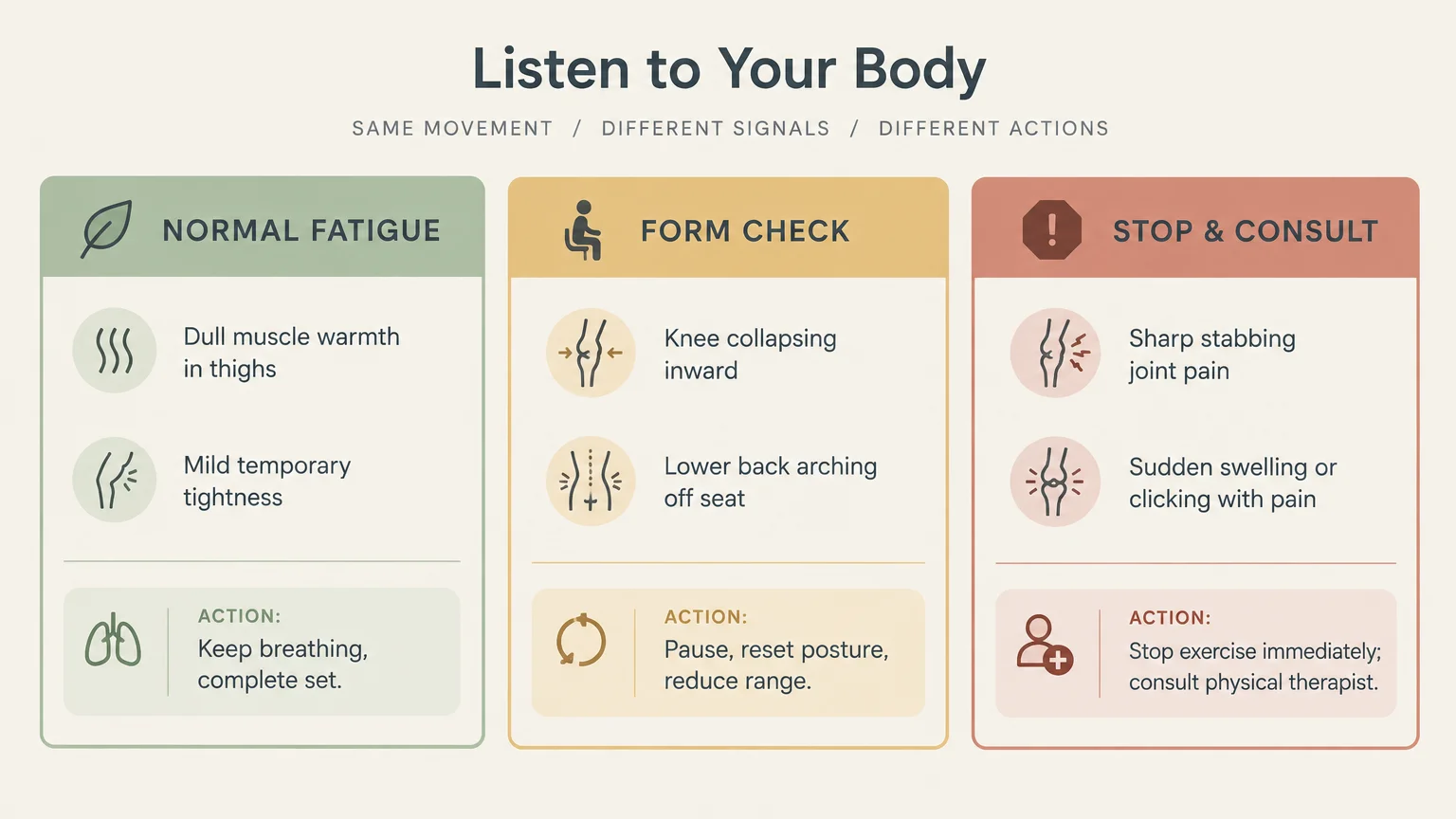
Mild muscle aching, slight fatigue, or gentle next-day soreness is completely normal when waking up sleepy thigh muscles, according to the Centers for Disease Control and Prevention and the North Bristol NHS Trust. That mild ache should gradually decrease as your legs adapt.
Sharp, stabbing, or persistent joint pain during a movement is never a goal to push through. The American Academy of Orthopaedic Surgeons emphasizes that you should not feel sharp pain inside the knee during any conditioning exercise.
If discomfort pops up mid-set, pause right away and inspect your alignment using National Health Service falls-service guidance. Check that your foot is aligned straight ahead, soften your knee slightly out of a rigid lock, and shorten your range of motion before trying gently again.
Should joint pain persist after adjusting your form, stop that exercise for the day. Always stop immediately and seek medical advice if new or worsening symptoms develop, if pain fails to improve over time, or if you suddenly feel dizzy or unwell.
Before starting any new routine, check in with your physician if you manage chronic medical conditions or have been inactive for a long stretch, as recommended by both the National Health Service and the National Institute on Aging. When severe stiffness or pain keeps you from exercising on your own, ask your doctor about a physical therapy referral—an approach advised in September 2026 American College of Rheumatology clinical guidance.
Frequently Asked Questions About Chair Exercises for Knees
Can seated exercises for seniors really build meaningful knee strength?
Yes, seated exercises place focused tension directly on your quadriceps, hamstrings, and hip stabilizers without jarring your cartilage. Even brief daily sessions count—Penn State research showed just 4 minutes a day of strength work significantly improved leg strength, balance, and chair-stand ability in adults 65 and older over 12 weeks.
How many days a week should I do chair exercises for knee pain?
Aim for 2 to 3 nonconsecutive days per week, aligning with guidelines from the National Health Service, the American Academy of Orthopaedic Surgeons, and the National Strength and Conditioning Association. Resting a day between strength sessions gives muscle fibers time to repair and grow stronger.
Should I exercise if my knees already feel stiff or arthritic?
Gentle movement usually eases stiffness by circulating nourishing fluid across joint surfaces, which is why the American College of Rheumatology names exercise a first-line osteoarthritis treatment. Start with a 30-second seated hip march or a few isometric quad squeezes, stopping immediately if you feel sharp joint pain.
When should I add ankle weights or resistance bands?
Hold off on added weights until you can complete 2 sets of 10 repetitions with slow, steady 10-second holds using body weight alone. Once your current routine feels effortless, consult a physical therapist or trainer before strapping on light ankle weights so extra load never strains tender joints.
What chair works best for knee exercises over 60?
Choose a firm, flat-seated dining or kitchen chair without wheels and without armrests for seated leg workouts so nothing bumps your elbows or thighs. Keep your feet flat on the floor with knees bent at 90 degrees, and switch to a sturdy chair with armrests if you later practice standing rises.
Start Stronger Today From Right Where You Sit
Building stronger knees after 60 does not require heavy iron, complicated gym machines, or painful high-impact drills. Every slow leg extension, gentle thigh squeeze, and mindful stretch reinforces the muscular armor protecting your joints for years to come.
Pick one solid, armless chair in your living room or kitchen today and check that your feet plant flat at 90 degrees. Pour a glass of water, warm up with 30 seconds of easy hip marching, and try just one set of each exercise twice this week.
Pay close attention to how much easier standing from your seat feels after two or three steady weeks. Little moments practiced consistently add up to steadier steps, stronger balance, and greater freedom in everything you love to do.
This article is for informational purposes only. Consult with a healthcare provider before making significant changes to your diet, exercise routine, or supplement regimen.