Swapping your usual jar of peanut butter for a cleaner option can boost your daily protein, steady your energy, and protect your heart. A single spoonful delivers satisfying healthy fats without weighing down your meal plan.
Standing in the grocery aisle, however, makes comparing labels tricky because misleading front-of-package claims hide added sugars and extra salt. Knowing which numbers truly matter turns a simple pantry staple into one of your smartest daily habits.
We evaluated nutrition panels and ingredient lists to rank the healthiest spreads available today. Here is how six standout jars compare so you can shop with complete confidence.
Why Peanut Butter Nutrition Matters After 60
As your body ages, maintaining muscle mass and cardiovascular strength becomes an everyday priority. Choosing nutrient-dense foods helps you meet those goals without forcing you to eat huge portions.
Peanuts offer a powerful combination of plant-based protein, fiber, and mostly monounsaturated fat. They also supply essential micronutrients, including niacin, vitamin E, folate, potassium, and magnesium.
The American Heart Association notes in its 2021 guidance and January 7, 2026 response to federal guidelines that prioritizing plant-based proteins like legumes and nuts supports heart health. That same guidance encourages you to minimize added sugars, sodium, and saturated fats.
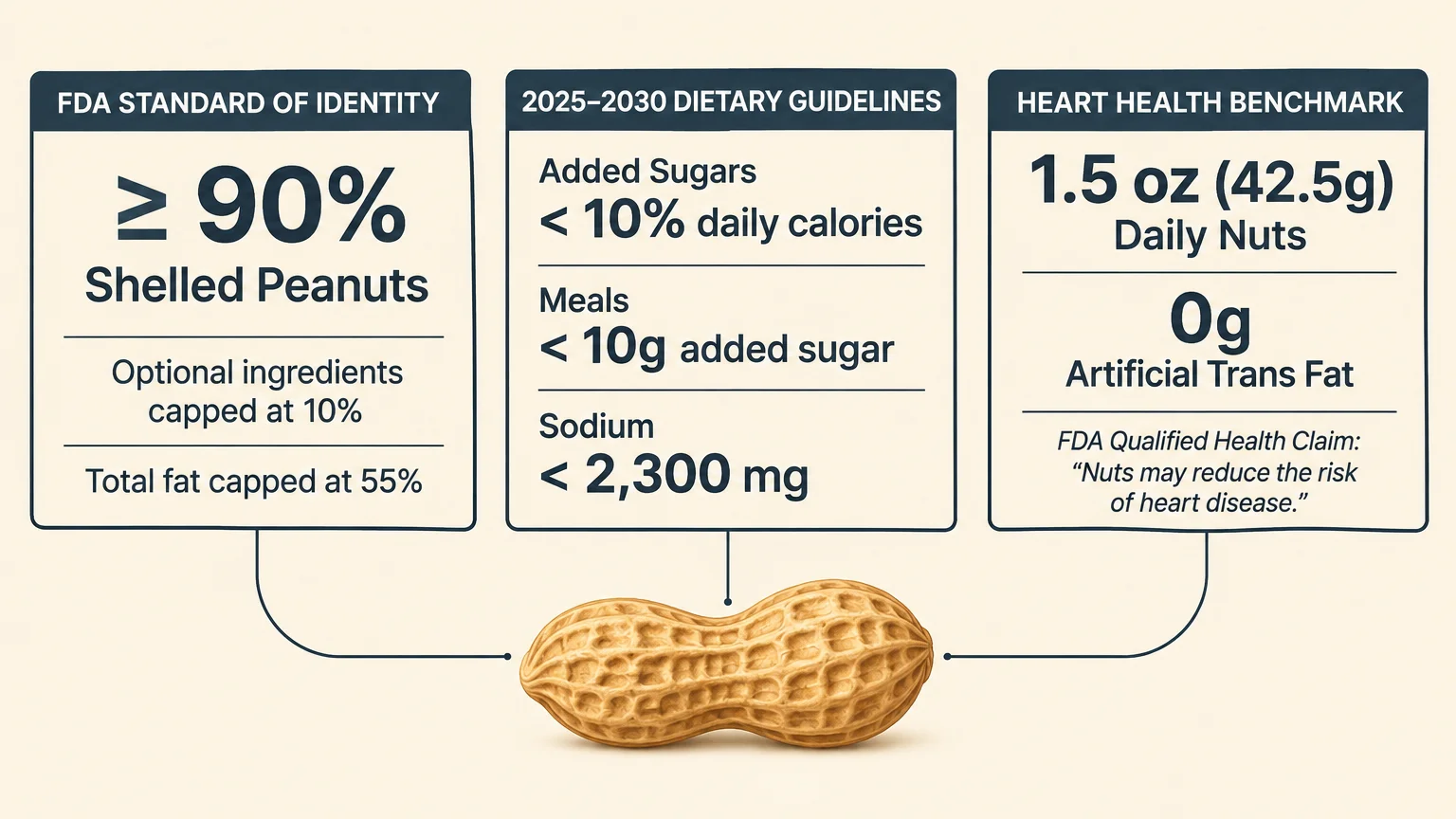
Select peanuts even carry the American Heart Association Heart-Check mark thanks to their favorable fat and micronutrient profile. Furthermore, the FDA permits a qualified health claim stating that scientific evidence suggests, though does not prove, eating 1.5 ounces (42.5 grams) of nuts daily may lower heart disease risk.
That benefit applies when nuts replace foods higher in saturated fat and cholesterol within an overall balanced diet. When you look at peanut butter nutrition through that lens, every ingredient inside the jar counts.
Under the 2025–2030 Dietary Guidelines for Americans, released on January 7, 2026 by the USDA and the Department of Health and Human Services, daily caps remain strict. Federal guidance recommends keeping saturated fat and added sugars each below 10 percent of daily calories.
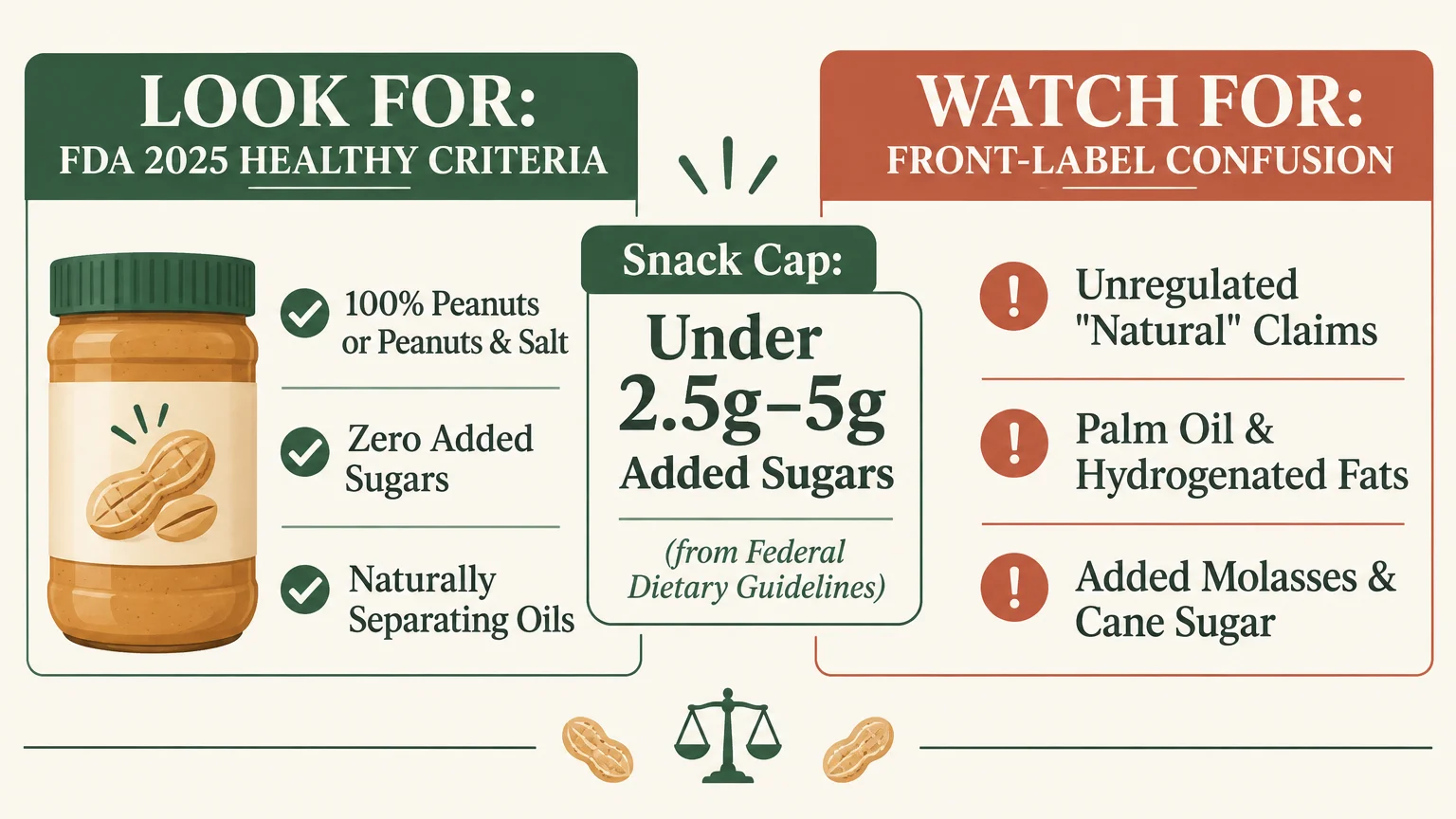
Those updated guidelines recommend no amount of added sugars at all, capping meals at under 10 grams and snack products at under 2.5 to 5 grams. Daily sodium intake should also stay below 2,300 milligrams.
Fortunately, federal food rules help protect what goes into your jar. Under the FDA Standard of Identity, peanut butter must consist of at least 90 percent shelled, roasted peanuts, with optional ingredients capped at 10 percent and total fat capped at 55 percent.
You also do not need to worry about artificial trans fats anymore. The FDA revoked safety status for partially hydrogenated oils in June 2015, enforced a compliance deadline on January 1, 2021, and finalized their removal from peanut butter standards on December 22, 2023.
A USDA Agricultural Research Service analysis of 11 commercial U.S. peanut butter brands found zero detectable trans-fatty acids. Conventional no-stir spreads now rely on palm oil or fully hydrogenated vegetable oils, neither of which contains trans fat.
Still, front labels can confuse smart shoppers searching for natural peanut butter. Because the FDA has no formal regulatory definition for the word natural, brands using sugar, molasses, and palm oil can still print that word on the lid.
Meanwhile, an updated FDA labeling rule from January 2025 clarifies what truly qualifies as healthy. Nuts and seeds containing no added ingredients other than water automatically meet the updated criteria, making single-ingredient spreads true healthy grocery picks.
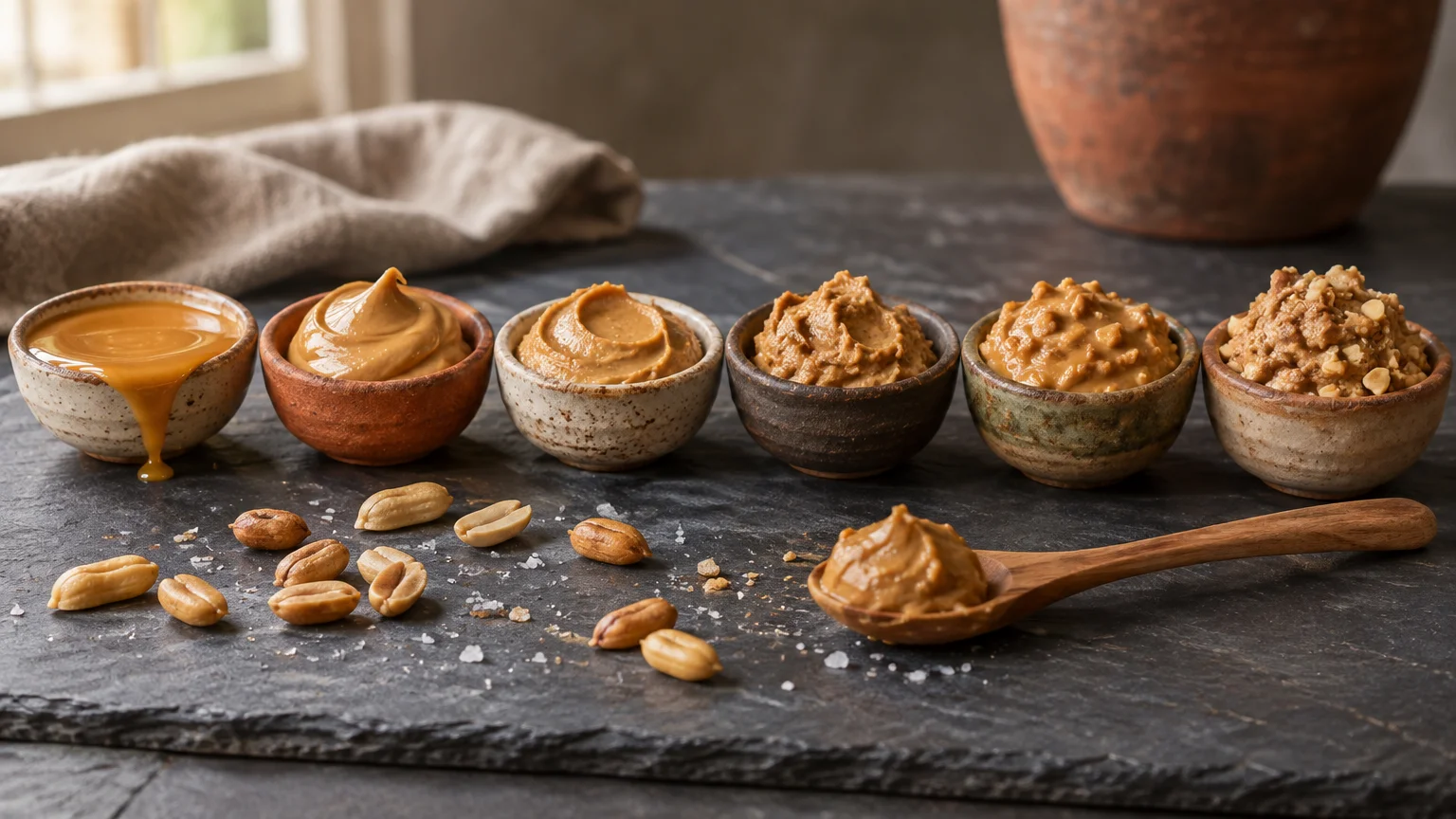
The Top 6 Peanut Butters Ranked by Nutrition
To determine the best peanut butter options for older adults, we looked closely at 2-tablespoon serving panels and compared them against the USDA FoodData Central baseline. Standard smooth peanut butter provides 188 calories, 15.9 grams of fat, 3 grams of saturated fat, 152.3 milligrams of sodium, 1.8 grams of fiber, 2.1 grams of sugar, and 7 grams of protein.
Our top healthiest peanut butter brands improve on that baseline by slashing sodium, eliminating added sugars, and keeping saturated fat low. Let us walk through the top six jars from cleanest to most indulgent.
1. Crazy Richard’s 100% Peanuts Creamy
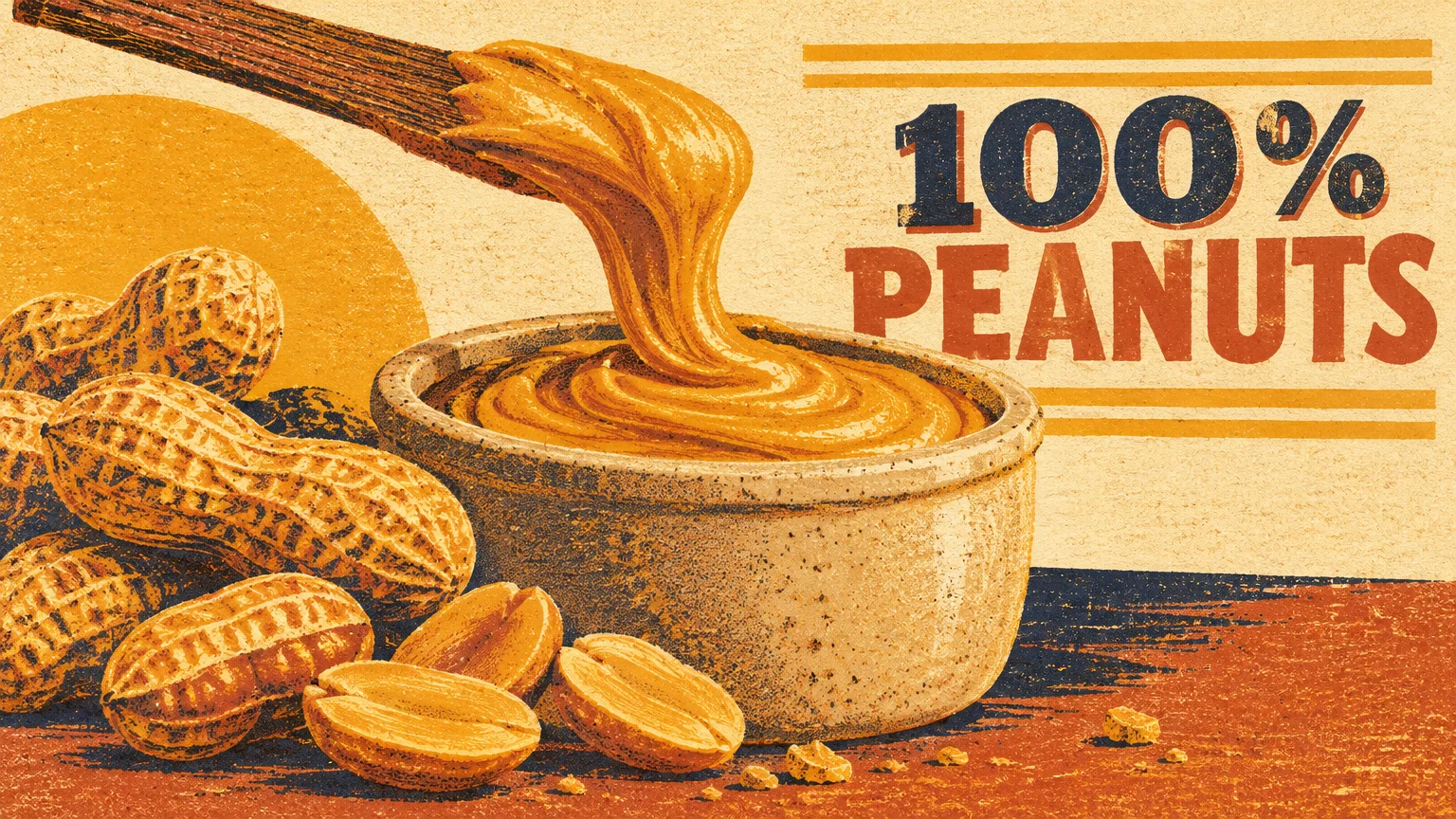
Crazy Richard’s 100% Peanuts Creamy claims the top spot because its ingredient list contains exactly one word: peanuts. There is no added salt, no sugar, and no stabilizing oil.
Each 32-gram serving delivers 190 calories, 16 grams of total fat, and just 2.5 grams of saturated fat with zero trans fat. You also get 0 milligrams of sodium, 7 grams of carbohydrates, 3 grams of fiber, 2 grams of naturally occurring sugar, and 8 grams of protein.
That extra gram of protein and fiber over standard commercial spreads makes a noticeable difference in fullness. If you watch your blood pressure closely, this jar gives you complete flavor without a single milligram of sodium.
Because nothing keeps the solids and liquids bound together, natural peanut oil rises to the top. Give the jar a thorough stir before your first scoop, and you will enjoy a light, pourable texture ideal for drizzling.
2. Teddie All Natural Smooth Unsalted
Teddie All Natural Smooth Unsalted ties Crazy Richard’s for nutritional purity while offering a slightly thicker, richer grind. Its sole ingredient is dry roasted peanuts.
A 32-gram serving provides 190 calories, 16 grams of total fat, 3 grams of saturated fat, and 0 milligrams of sodium. It matches the top spot with 7 grams of carbohydrates, 3 grams of fiber, 2 grams of natural sugar, zero added sugar, and 8 grams of protein.
Teddie also calls out 203 milligrams of potassium per serving on its nutrition panel. Potassium helps counter the effects of dietary sodium and supports healthy nerve and muscle function as you age.
Many longtime peanut butter fans prefer Teddie because its grind feels hearty rather than runny. If you crave classic mouthfeel without added salt or sugar, keep this jar near the front of your pantry.
3. Once Again Organic Unsweetened and Salt Free Creamy
Once Again Organic Unsweetened and Salt Free Creamy earns third place with USDA Organic certification and the lowest fat numbers on our list. Its ingredient list contains only dry roasted blanched organic peanuts.
A 2-tablespoon serving clocks in at 190 calories with just 14 grams of total fat and 2 grams of saturated fat. It provides 0 milligrams of sodium, 7 grams of carbohydrates, 2 grams of fiber, 2 grams of natural sugar, zero added sugar, and 8 grams of protein.
Blanching removes the thin red peanut skins before roasting, creating a notably smooth and mild spread. That milder taste pairs wonderfully with savory sauces, morning smoothies, or delicate baked goods.
With only 2 grams of saturated fat per serving, this jar is especially friendly for strict cholesterol-lowering meal plans. Choosing USDA Organic also appeals to shoppers who want peanuts grown without synthetic pesticides.
4. Santa Cruz Organic Creamy Dark Roasted
Santa Cruz Organic Creamy Dark Roasted introduces a small pinch of salt while maintaining impressive nutritional balance and USDA Organic status. Its ingredients consist of organic roasted peanuts and 1 percent or less of salt.
Depending on the label revision, a 32-gram serving supplies 200 to 210 calories, 16 to 17 grams of total fat, and 2.5 grams of saturated fat. It contains 50 milligrams of sodium, 6 grams of carbohydrates, 2 grams of fiber, 1 gram of total sugar, zero added sugar, and 7 grams of protein.
Deep roasting unlocks a bold, nutty aroma that makes unsalted spreads taste bland by comparison. Even better, that 50-milligram sodium figure represents only a tiny fraction of your daily 2,300-milligram limit.
If unsalted nut butters leave your palate wanting more, Santa Cruz offers a satisfying middle ground. You get rich flavor and zero added sugar without loading up on salt.
5. Smucker’s Natural Creamy
Smucker’s Natural Creamy stands out as one of the easiest healthy grocery picks to find in standard neighborhood supermarkets. Its two-ingredient formula uses only peanuts and 1 percent or less of salt.
Every 32-gram serving brings 190 calories, 16 grams of total fat, 3 grams of saturated fat, and 0 grams of trans fat. It also delivers 7 grams of carbohydrates, 3 grams of fiber, 2 grams of natural sugar, zero added sugar, 8 grams of protein, and 201 milligrams of potassium.
Sodium rises slightly here to 110 milligrams per serving, which places it behind Santa Cruz in our ranking. Still, 110 milligrams remains well below the 152.3-milligram sodium baseline of standard commercial smooth spreads.
Because most grocery chains stock Smucker’s Natural year-round, you do not need a specialty market to eat well. It gives you 8 grams of protein, 3 grams of fiber, and dependable value in one familiar jar.
6. Justin’s Classic Peanut Butter
Justin’s Classic Peanut Butter takes sixth place because it trades pure peanut simplicity for no-stir convenience. Its ingredient panel lists dry roasted peanuts and palm oil.
A 32-gram serving packs 210 calories, 18 grams of total fat, and 3.5 grams of saturated fat. It stays impressively low in sodium at 25 milligrams, alongside 6 grams of carbohydrates, 1 gram of fiber, 2 grams of natural sugar, zero added sugar, and 7 grams of protein.
Adding palm oil keeps the oil from separating, which helps if stiff wrists or arthritis make stirring natural jars difficult. However, palm oil pushes total calories up to 210, increases saturated fat to 3.5 grams, and trims dietary fiber down to 1 gram.
Even with those trade-offs, Justin’s Classic contains zero added sugar and far less sodium than typical salted brands. It works well as a practical compromise when convenience matters most.
How Conventional Spreads Compare: Jif Natural and Regular Jif
Comparing our top six spreads against familiar shelf staples reveals how quickly hidden ingredients add up. Consider Jif Natural Creamy, which puts the word natural right on its label.
Its 33-gram serving contains roasted peanuts, sugar, palm oil, and 2 percent or less of salt and molasses. That translates to 190 calories, 16 grams of fat, 3.5 grams of saturated fat, 80 milligrams of sodium, 8 grams of carbohydrates, 3 grams of fiber, 4 grams of total sugars with 2 grams of added sugars, and 7 grams of protein.
Regular Jif Creamy goes a step further by adding fully hydrogenated rapeseed and soybean oils plus mono and diglycerides alongside sugar and molasses, yielding 3 grams of total sugars. While neither spread contains trans fat, you give up clean nutrition for unnecessary sweeteners and extra saturated fat.
Checking the ingredient list stops marketing buzzwords from fooling your grocery budget. When you know what to compare, picking the best peanut butter takes just five seconds.
Benefits of Choosing Cleaner Peanut Butter and Signs You Need More
Upgrading your pantry jar pays dividends you can feel throughout the day. Pairing plant protein with monounsaturated fats slows digestion, helping keep mid-morning hunger and afternoon energy dips at bay.
Each 2-tablespoon scoop from top brands delivers 7 to 8 grams of protein to support muscle repair after daily walks or strength exercises. Meanwhile, 2 to 3 grams of dietary fiber gently support digestive regularity.
Choosing zero-sodium or ultra-low-sodium jars also protects your daily salt budget for other meals. Adding roughly 200 milligrams of potassium per serving from brands like Teddie or Smucker’s further supports balanced blood pressure.
On the flip side, certain daily habits signal that your snacks need a nutritional upgrade. If your stomach growls an hour after toast or cereal, refined carbohydrates without protein or healthy fat may be to blame.
Feeling sluggish between meals or relying on sugary pastries for quick afternoon fuel also points toward a gap in steady energy. Swapping sweet spreads for clean peanut butter anchors your snacks with lasting fuel.
If your routine labs show rising cholesterol or blood pressure, trading butter, processed deli meats, or sugary spreads for unsalted nut butter aligns directly with federal heart-health advice. Small daily swaps compound into meaningful long-term benefits.

How to Easily Add Healthy Peanut Butter to Your Daily Routine
Bringing healthier spreads into your kitchen does not require complicated recipes. You can upgrade familiar meals in less than two minutes using simple pairings.
For breakfast, swirl a tablespoon of warm natural peanut butter into steel-cut oats or plain Greek yogurt. The heat melts the spread effortlessly, turning plain grains into a creamy, protein-rich start to your morning.
At lunch, spread Crazy Richard’s or Teddie on whole-grain toast and top it with sliced strawberries or mashed raspberries. Berries provide natural sweetness without needing sugary jelly or syrup.
For an effortless afternoon snack, pair 2 tablespoons of Santa Cruz or Smucker’s Natural with crisp apple wedges or celery stalks. You get satisfying crunch, hydration, and 7 to 8 grams of protein in minutes.
Peanut butter also shines in savory dinners when you want variety beyond sweet dishes. Whisk 2 tablespoons of unsalted peanut butter with a splash of warm water, low-sodium soy sauce, and rice vinegar to drizzle over steamed broccoli and brown rice.
When shopping, flip every jar over before putting it in your cart. Look for one or two ingredients on the label, zero grams of added sugar, and 3 grams or less of saturated fat per serving.
Once you bring natural peanut butter home, smart storage prevents messy oil separation. According to the U.S. National Peanut Board, unopened peanut butter stays fresh for 6 to 9 months in the pantry and 2 to 3 months after opening.
Natural oil separation is completely normal and never indicates spoilage. If stirring a brand-new jar hurts your hands or wrists, let the closed jar sit upside down overnight so the oil moves toward the bottom.
After stirring thoroughly with a sturdy butter knife, pop the jar into the refrigerator. Brands like Once Again note that refrigerating stirred natural peanut butter prevents the oil from separating again and keeps it fresh for up to 3 months after opening.
If refrigerated peanut butter feels too firm for delicate bread, scoop out your 2-tablespoon portion and let it sit on the counter for ten minutes. It softens quickly without losing its smooth, cohesive texture.
What to Consider Before Filling Your Cart
Even the healthiest pantry staple requires thoughtful portion awareness and attention to personal health needs. Because peanut butter packs 190 to 210 calories into just 2 tablespoons, eyeballing scoops straight from the jar adds extra calories fast.
Use an actual measuring spoon for a week until you recognize what a true 2-tablespoon serving looks like. Remember that the FDA qualified heart-health claim references 1.5 ounces, or 42.5 grams, of nuts per day—roughly 2.5 to 3 tablespoons if peanuts are your only nut source that day.
Food safety also deserves brief attention when storing nut products. Peanuts can occasionally harbor aflatoxins, which are carcinogenic toxins produced by Aspergillus molds and classified as Group 1 human carcinogens by the IARC.
In the United States, the FDA enforces a strict action level capping total aflatoxins at 20 parts per billion in human foods including peanut butter. By comparison, the European Union sets an even tighter limit of 4.0 parts per billion for ready-to-eat peanut products.
Buying fresh jars from reputable national brands and storing them in a cool pantry or refrigerator minimizes mold growth risks. Always discard any nut butter that smells stale, tastes bitter, or shows visible mold.
Think about texture and swallowing comfort as well. Thick nut butters can stick to the roof of your mouth or feel dry if you experience dry mouth from daily medications.
Thinning your portion into warm oatmeal, smoothies, or yogurt makes swallowing safe and effortless. For broader evidence-based health information, you can always browse resources at the NIH.
If you manage kidney disease, severe hypertension, or food allergies, check with your physician before increasing nut intake. A registered dietitian found through the Academy of Nutrition and Dietetics can also help tailor peanut butter portions to your exact medical goals and medications.
Frequently Asked Questions About Peanut Butter Nutrition
How much peanut butter should you eat per day?
A standard serving is 2 tablespoons, or 32 grams, which supplies around 190 calories and 7 to 8 grams of protein. For heart benefits, the FDA qualified health claim points to 1.5 ounces (42.5 grams) of nuts daily within a diet low in saturated fat and cholesterol.
Does natural peanut butter or regular peanut butter contain trans fats?
No, commercial U.S. peanut butters do not contain artificial trans fats anymore. Following the FDA’s phase-out of partially hydrogenated oils, a USDA Agricultural Research Service test of 11 commercial brands found zero detectable trans-fatty acids.
Should you refrigerate natural peanut butter after opening?
Refrigeration is not strictly required for safety, because the U.S. National Peanut Board notes opened jars stay safe in the pantry for 2 to 3 months. However, refrigerating stirred natural jars prevents oil from separating again and preserves freshness for up to 3 months.
Is organic peanut butter nutritionally better than conventional natural brands?
Macronutrients remain nearly identical across organic and conventional single-ingredient spreads. For example, Once Again Organic and Crazy Richard’s both deliver 190 calories, 8 grams of protein, and 0 milligrams of sodium, so choosing organic mostly comes down to preferring crops grown without synthetic pesticides.
Why does natural peanut butter sometimes contain sugar and palm oil?
The FDA has not established a formal legal definition for the word natural on food packages. Because of that gap, spreads like Jif Natural can use that term on the front label even when the jar contains sugar, molasses, and palm oil.
How much difference does unsalted versus lightly salted peanut butter make?
Choosing Crazy Richard’s, Teddie Unsalted, or Once Again cuts sodium to 0 milligrams per serving. Lightly salted picks like Santa Cruz add 50 milligrams and Smucker’s Natural adds 110 milligrams, both remaining modest compared with the 2,300-milligram daily limit.
Simple Steps to Upgrade Your Pantry This Week
Finding the healthiest peanut butter brands does not mean sacrificing flavor or convenience. Single-ingredient spreads like Crazy Richard’s, Teddie All Natural Unsalted, and Once Again give you pure peanuts, 8 grams of protein, zero sodium, and zero added sugar.
If you prefer a subtle pinch of salt or a no-stir texture, Santa Cruz Organic, Smucker’s Natural, and Justin’s Classic still keep added sugars at zero. Start by reading the ingredient label on the jar sitting in your kitchen today.
On your next grocery trip, pick one of the top zero-added-sugar spreads from this list and stir it once before placing it in your refrigerator. Measure out a 2-tablespoon scoop over morning oatmeal or afternoon apple slices, and enjoy an easy nutritional upgrade all week long.
This article is for informational purposes only. Consult with a healthcare provider before making significant changes to your diet, exercise routine, or supplement regimen.