Deciding which winter vaccines you need after age 65 can feel confusing when guidelines shift each year. Knowing the exact timing and formulas for flu, COVID-19, and RSV shots protects your health without guesswork.
Updated 2026–2027 guidance introduces a new mRNA flu option, a two-dose COVID-19 schedule for older adults, and revised RSV eligibility. Each shot targets a distinct respiratory virus that behaves differently inside an aging body.
Understanding how these vaccines work—and how Medicare covers them—helps you build a practical winter defense plan.
Why Winter Respiratory Viruses Hit Harder After 65
As you age, your immune system undergoes a gradual slowdown called immunosenescence. Think of it like a neighborhood watch whose experienced patrols respond a bit more slowly to an unfamiliar intruder.
Your body produces fewer naive T-cells, which are the frontline scouts that recognize new viral variants. Antibody levels generated from past infections or older shots also fade faster than they did in your thirties.
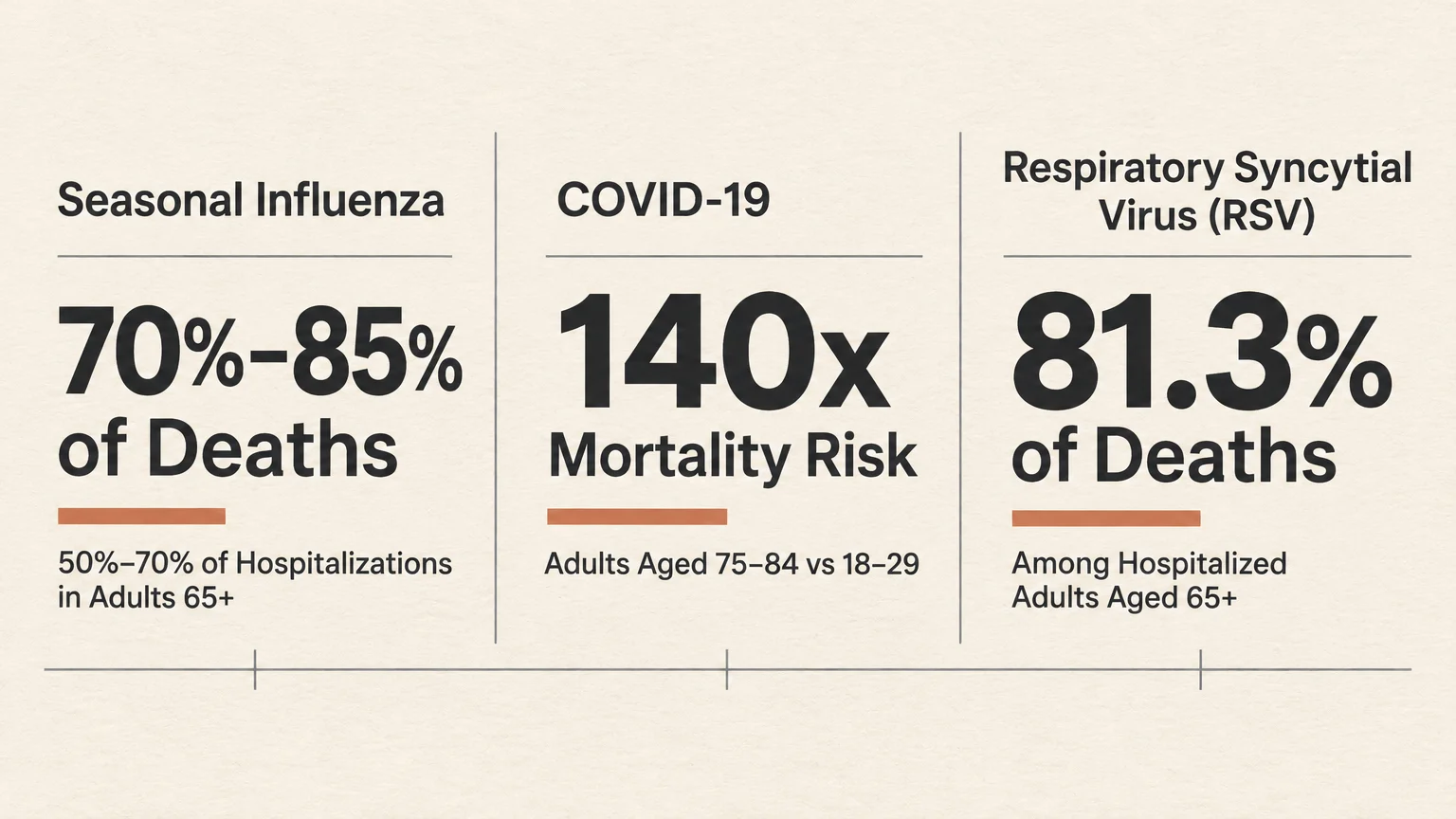
Data from the Centers for Disease Control and Prevention (CDC) shows adults aged 65 and older account for 70% to 85% of seasonal flu deaths. This same age group also makes up 50% to 70% of flu hospitalizations.
COVID-19 carries an even steeper age gradient. CDC figures indicate that adults aged 75 to 84 face roughly 140 times the risk of dying from COVID-19 compared to adults aged 18 to 29.
Respiratory syncytial virus—commonly known as RSV—poses a major hidden threat as well. CDC estimates show RSV causes 110,000 to 180,000 hospitalizations each year among adults aged 50 and older.
An October 2026 CDC analysis presented at IDWeek found that 8.6% of adults hospitalized with RSV died in the hospital or within 30 days of discharge. Adults aged 65 and older accounted for 81.3% of those deaths.
Vaccines act like updated training briefings for those slower immune scouts. Instead of learning how to fight a virus during a severe infection, your body practices safely in advance.
The 2026–2027 Flu Shot: Enhanced Protection and a New mRNA Option
Getting an annual flu shot for older adults remains the cornerstone of winter prevention. During the 2025–2026 flu season, interim CDC estimates cited by CIDRAP and the American Medical Association (AMA) recorded at least 390,000 hospitalizations and roughly 24,000 deaths.
That followed an even harsher 2024–2025 season that saw more than 710,000 hospitalizations and 45,000 deaths. A September 2026 CIDRAP and AMA review confirmed that flu vaccination cut hospitalization risk by 31% in adults aged 65 and older.
Because standard shots trigger weaker responses in aging immune systems, CDC Interim Clinical Considerations updated in September 2026 keep preferential rules in place. Adults aged 65 and older should preferentially receive one of three enhanced flu vaccines.
The Three Preferential Senior Flu Vaccines
Fluzone High-Dose contains four times the antigen found in a standard flu shot. That extra viral protein gives your immune system a louder signal to produce protective antibodies.
Fluad uses a standard antigen dose paired with an adjuvant—an added ingredient that acts like a megaphone for your immune response. It boosts antibody production and helps protection last deeper into spring.
Flublok is a recombinant vaccine made without chicken eggs or live influenza virus. It delivers three times the antigen of a standard shot for stronger, more precise antibody matching.
If a clinic or pharmacy is temporarily out of all three preferential formulations, do not walk away unprotected. CDC advises taking any age-appropriate flu vaccine without delay rather than risking exposure.
A New Milestone: The First Approved mRNA Flu Shot
On August 5, 2026, the U.S. Food and Drug Administration (FDA) approved Moderna’s mFLUSIVA (mRNA-1010), marking the first mRNA influenza vaccine cleared for adults aged 50 and older. It received traditional approval for ages 50 to 64 and accelerated approval for ages 65 and older.
Instead of delivering lab-grown viral proteins, mRNA works like a temporary recipe card. Your cells read the genetic instructions, build harmless spike-like flu proteins, and quickly recycle the recipe card afterward.
In a Phase 3 trial involving 40,805 adults aged 50 and older, mFLUSIVA showed 26.6% higher relative efficacy against lab-confirmed flu than a standard-dose shot. Guidance from the American Academy of Family Physicians (AAFP) for 2026–2027 includes mFLUSIVA among enhanced options for adults over 65.
Updated Trivalent Strains and Timing Rules
Following a unanimous 7–0 advisory vote in March 2026, FDA directed manufacturers to update every component of the 2026–2027 U.S. flu vaccine. All U.S. formulas are now trivalent, meaning they target three key influenza strains.
Crucially, the updated formula targets influenza A(H3N2) subclade K. That specific strain accounted for 93% of genetically characterized H3N2 samples in CDC’s 2025–2026 interim surveillance report.
Egg-based shots target A/Missouri/11/2025 (H1N1)pdm09-like, A/Darwin/1454/2025 (H3N2)-like, and B/Tokyo/EIS13-175/2025 (B/Victoria lineage)-like viruses. Cell-, recombinant-, and nucleic acid-based shots substitute A/Darwin/1415/2025 (H3N2)-like and B/Pennsylvania/14/2025 (B/Victoria lineage)-like strains.
Timing matters just as much as formulation when planning your winter vaccines. CDC advises getting your flu shot ideally in September or October, though vaccination remains worthwhile as long as flu viruses circulate.
Older adults should generally avoid getting a flu shot in July or August unless returning later is impractical. Early summer vaccination increases the risk that your antibodies will wane before winter peaks.
If you have an egg allergy, you can safely receive any age-appropriate flu vaccine without special medical monitoring. CDC also recommends choosing single-dose, thimerosal-free formulations, which are widely stocked at pharmacies.
The 2026–2027 COVID-19 Booster: Why Two Doses Matter Now
Severe illness from SARS-CoV-2 has declined since the pandemic’s worst years, yet older adults still carry the heaviest burden. During the 2025–2026 season, COVID-19 caused an estimated 4.6 million to 12.9 million illnesses and 15,000 to 42,000 deaths.
Even though peak weekly hospitalizations sat roughly 80% below the 2022–2023 peak, protection from older shots fades rapidly. A 2026 CIDRAP and AMA review found that updated COVID-19 vaccines reduced hospitalization risk by 53% in adults aged 65 and older.
The Updated Variant Formula
In late May 2026, FDA advised vaccine makers to target the monovalent Omicron JN.1-lineage XFG strain. Monovalent means the formula focuses all of your immune system’s attention on one prevailing variant family rather than splitting effort across outdated strains.
FDA approved four updated 2026–2027 vaccines for adults aged 65 and older: Moderna Spikevax, Moderna mNexspike, Pfizer-BioNTech Comirnaty, and Novavax/Sanofi Nuvaxovid. The first three use mRNA technology, while Nuvaxovid offers a traditional protein subunit option paired with an adjuvant.
CDC expresses no preference among these four 2026–2027 products. However, clinicians are advised not to administer leftover 2025–2026 formulas once updated doses arrive.
Why Seniors Need Two Doses Six Months Apart
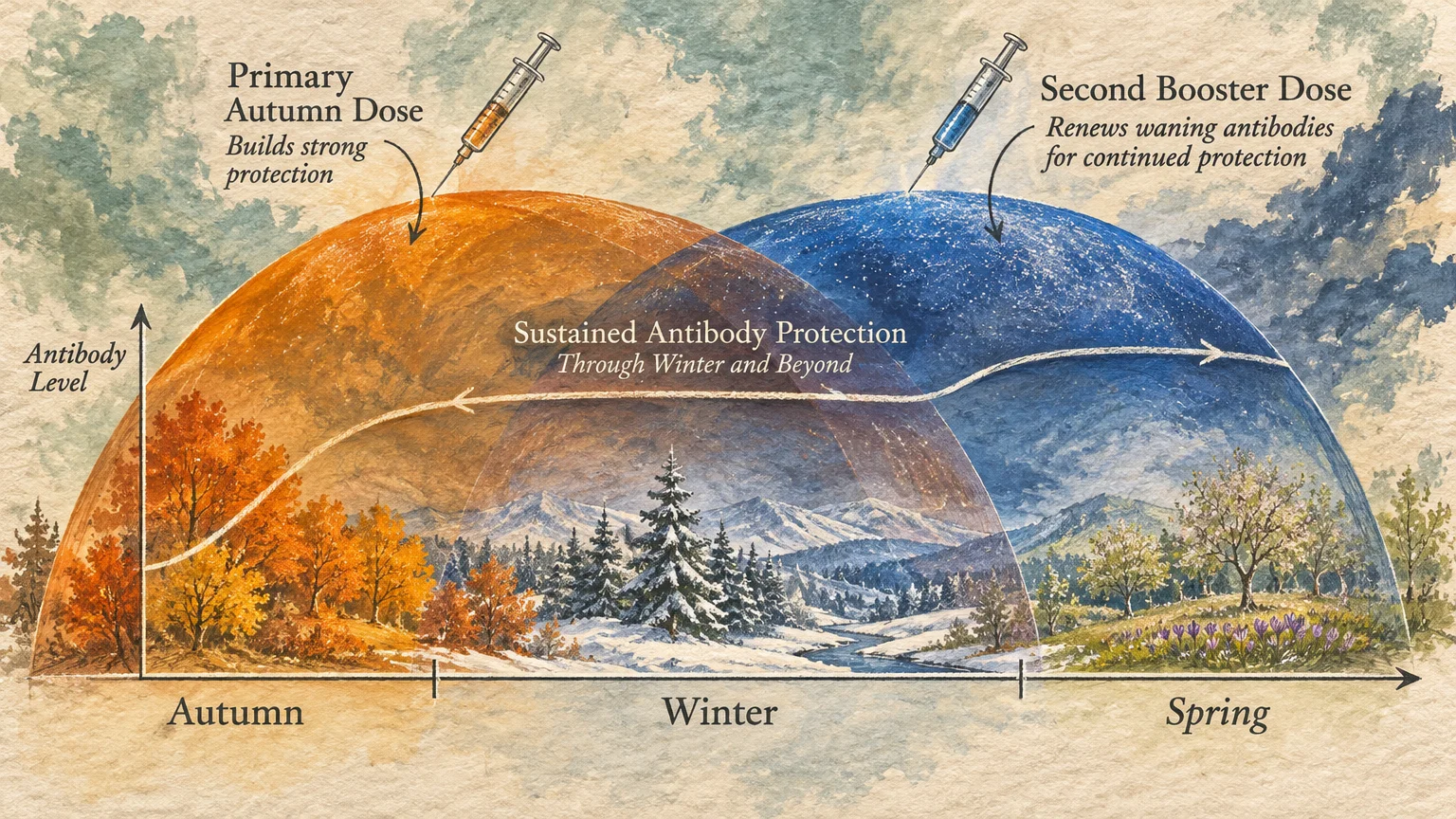
Updated CDC guidance clarified in September 2026—aligned with recommendations from the American Geriatrics Society (AGS)—sets a distinct schedule for your COVID booster 2026 plan. While younger adults generally need one annual dose, immunocompetent adults aged 65 and older should receive two doses.
You should space those two doses six months apart, with a minimum allowable interval of two months if travel or local surges require earlier boosting. Think of the second dose as topping off a battery that naturally loses charge faster after age 65.
Because COVID-19 surges often strike in both late winter and late summer, a six-month spacing keeps your neutralizing antibodies active year-round. Taking your first dose in September or October positions your second dose nicely for March or April.
If you are moderately or severely immunocompromised—for example, due to active cancer treatment, organ transplants, or immune-suppressing medications—you may receive additional doses. CDC allows you to self-attest your immunocompromised status at the pharmacy without bringing doctor’s notes or medical paperwork.
The RSV Vaccine: One Dose, Lasting Coverage, and Updated Age Rules
Many older adults mistake RSV for a mild childhood cold, yet it inflames the tiny airways of aging lungs just as aggressively as influenza. Across all ages during 2025–2026, RSV caused 170,000 to 340,000 hospitalizations and up to 25,000 deaths.
Real-world studies reviewed by CIDRAP and the AMA in 2026 showed the RSV vaccine for seniors delivers 69% to 83% effectiveness against RSV hospitalization during the vaccination season. That high protection makes checking your eligibility one of the smartest steps you can take.
Who Qualifies Under Revised 2026 Rules
Following a 2025 expansion downward from age 60 to age 50, CDC guidance revised in February 2026 creates two clear eligibility tiers. First, every adult aged 75 and older is recommended to get vaccinated regardless of overall health.
Second, adults aged 50 to 74 are recommended to get vaccinated if they face increased risk of severe RSV. Qualifying conditions include chronic heart or lung disease, weakened immunity, complicated diabetes, end-stage renal disease, certain neurologic conditions, or nursing home residency.
If you are between 50 and 74 and your only condition is well-controlled, isolated high blood pressure, you do not currently qualify under high-risk criteria. Speak with your primary care clinician if you are unsure whether your medical history qualifies.
A Single Dose—Not an Annual Shot
Unlike flu and COVID-19 vaccines, the RSV shot is not an annual vaccine. CDC emphasizes that one dose provides durable protection lasting at least two years.
If you already received an RSV vaccine during an earlier season, you should not get another dose right now. Keep your vaccination card or pharmacy receipt handy so you avoid duplicate dosing.
Approved RSV Products, Timing, and Safety Context
Three FDA-licensed RSV vaccines are available for adults aged 50 and older, with no official preference among them. Your options include GSK’s Arexvy (adjuvanted protein subunit), Pfizer’s Abrysvo (protein subunit), and Moderna’s mResvia (mRNA).
CDC advises getting your RSV shot in late summer or early fall—ideally September or October—right before the U.S. RSV season begins. RSV activity typically runs from October through March and peaks in December and January.
Transparency around side effects helps you weigh risks calmly. In January 2025, FDA added a Guillain-Barré syndrome (GBS) warning to the prescribing labels of Abrysvo and Arexvy based on Medicare postmarketing safety data.
Guillain-Barré syndrome is a rare nervous system disorder where your immune system mistakenly irritates peripheral nerves, causing temporary tingling or muscle weakness. Postmarketing data showed an estimated 9 excess GBS cases per million doses of Abrysvo and 7 excess cases per million doses of Arexvy within 42 days in adults 65 and older.
Put another way, that equals fewer than one extra case for every 100,000 older adults vaccinated. Both FDA and CDC conclude that the substantial protection against deadly RSV pneumonia clearly outweighs this very rare risk.

Timing, Co-Administration, and Managing Side Effects
Once you know which vaccines over 65 apply to you, scheduling becomes your next practical hurdle. CDC confirms that you can safely receive your flu, COVID-19, and RSV vaccines during the exact same appointment.
When a pharmacist gives multiple injectable vaccines in one visit, they place each shot at a separate injection site—either in opposite arms or spaced at least one inch apart. That spacing keeps localized soreness from overlapping and helps clinicians identify which shot caused any mild skin redness.
Combining visits works well if transportation is difficult or you want full protection locked in before holiday travel. However, getting two or three shots together can slightly increase short-term reactions like arm tenderness, fatigue, headaches, or low-grade muscle aches.
If you prefer a gentler recovery, you can space your appointments out by a week or two. CDC confirms there is no mandatory waiting period between flu, COVID-19, and RSV shots.
A smart two-visit approach involves pairing your flu shot and RSV shot (if you have never had RSV vaccination) in September, then getting your updated COVID-19 booster a week or two later in October. Always ask your pharmacist whether a non-mRNA option like Nuvaxovid or Flublok fits your past side-effect history.
If mild aches or fatigue show up afterward, drink plenty of water and rest your arm with gentle movement. Avoid taking pain relievers like ibuprofen or acetaminophen before your appointment, though you can ask your doctor about using them afterward for comfort.
Navigating Medicare, Insurance, and Out-of-Pocket Costs
Understanding how insurance pays for winter vaccines prevents frustrating surprise bills at the checkout counter. Medicare splits respiratory vaccines across two completely different coverage rules.
Medicare Part B covers both your annual flu shot and your 2026–2027 COVID-19 shots at $0 out of pocket. You owe no copay, and the standard $283 Medicare Part B deductible for 2026 does not apply as long as the provider accepts Medicare assignment.
If you are homebound or living with a disability that makes clinic trips hard, Medicare Part B also covers in-home flu and COVID-19 vaccination at $0. Call your primary care clinic or local public health department to arrange a visiting nurse.
Medicare Part D—your prescription drug plan—covers the RSV vaccine at $0 with no copay or deductible under federal Inflation Reduction Act rules. However, Part D carries an important practical trap you need to avoid.
Most Medicare Part D plans treat retail pharmacies as in-network providers, not doctors’ offices. If you get your RSV shot inside your physician’s clinic, the office may ask you to pay upfront and submit paperwork for reimbursement later.
Additionally, if you carry Original Medicare (Parts A and B) without a Part D prescription drug plan, Medicare will not cover your RSV shot at all. Always confirm your Part D pharmacy benefits before rolling up your sleeve.
If you receive Medicaid, state programs generally cover all ACIP-recommended adult vaccines at $0 cost-sharing, though exact logistics vary by state. Most Affordable Care Act (ACA) compliant private insurance plans also cover these recommended shots at $0.
Without any insurance, cash prices add up quickly in 2026. Standard flu shots run roughly $22 to $70, while high-dose or adjuvanted senior formulations range from $62 to $130 plus possible clinic administration fees.
Uninsured COVID-19 doses cost roughly $130 to $300 out of pocket—with 2026 retail self-pay prices reaching $278.99 for Pfizer or Novavax and $298.99 for Moderna mNexspike, though discount coupons can lower prices near $130. Uninsured RSV shots average around $350, ranging between $300 and $550.

Proactive Steps Beyond Your Pharmacy Visit
Survey data from CDC covering through October 31, 2026, reveals that many seniors still leave protection on the table. Only 57.6% of adults aged 65 and older had received a 2026–2027 flu shot, and just 27.3% had received the updated COVID-19 shot.
Meanwhile, only 41.4% of adults aged 75 and older reported ever receiving an RSV vaccine. Taking a few deliberate steps turns confusing guidelines into reliable protection.
First, pull your immunization history before booking an appointment. Check your patient portal, Medicare summary notices, or pharmacy app to verify whether you already received an RSV shot in 2023, 2024, or 2025.
Second, verify specific product availability when booking online. Ask your pharmacist ahead of time whether they have Fluzone High-Dose, Fluad, Flublok, or mFLUSIVA in stock so you do not settle unnecessarily for a standard-dose flu shot.
Third, mark your six-month COVID-19 booster date on your calendar right after your fall dose. Setting a reminder for March or April ensures you follow the two-dose senior schedule without forgetting.
Fourth, pair vaccination with everyday respiratory hygiene during peak winter waves. Improving indoor airflow when hosting grandchildren, washing hands thoroughly, and keeping rapid COVID-19 tests at home help you act fast if symptoms start.
Acting quickly matters because prescription antivirals like Paxlovid for COVID-19 and Tamiflu for influenza work best within the first couple of days of illness. For broader healthy aging guidance, visit the National Institutes of Health (NIH) or explore global respiratory updates from the World Health Organization (WHO).
What Scientists Are Still Exploring
Vaccine science moves fast, and researchers are actively studying several open questions that will shape future winter seasons. Confirming long-term real-world durability remains at the top of the list.
Because Moderna’s mFLUSIVA received accelerated approval for adults aged 65 and older, scientists are conducting confirmatory postmarketing trials. Those studies will track how well mRNA flu shots prevent hospitalizations and severe complications compared to established high-dose and adjuvanted shots.
Immunologists are also tracking how long a single RSV shot maintains strong lung protection beyond two years. Future guidance will clarify whether older adults eventually need an RSV booster every three to five years or even longer.
Finally, clinical trials are evaluating combination vaccines that pack flu, COVID-19, and potentially RSV antigens into a single needle. Simplifying your fall schedule down to one injection could dramatically boost senior uptake in coming winters.
Frequently Asked Questions About Winter Vaccines Over 65
Can I get my flu, COVID-19, and RSV shots on the same day?
Yes, CDC confirms that getting all three vaccines in a single visit is safe and effective. Your pharmacist will administer each shot in a different arm or spaced at least one inch apart, though combining them may slightly increase temporary fatigue or arm soreness.
How do I know if I already need another RSV vaccine this winter?
You do not need another RSV shot if you already received one during a previous season. CDC emphasizes that the RSV vaccine is not annual and protects for at least two years after a single dose.
What if my local pharmacy runs out of high-dose flu shots?
You can ask for Fluad (adjuvanted), Flublok (recombinant), or mFLUSIVA (mRNA), all of which offer enhanced protection for older adults. If none of those enhanced choices are available, CDC advises getting any age-appropriate flu vaccine rather than delaying protection.
Why does my doctor say I need two COVID-19 shots this year?
Updated 2026–2027 CDC and American Geriatrics Society guidance recommends two COVID-19 doses spaced six months apart for adults aged 65 and older. Immunity fades more quickly after age 65, so a second dose maintains steady protection through spring and summer.
Will Medicare pay for my RSV shot at my doctor’s office?
Usually not directly, because Medicare Part D covers RSV vaccines primarily through in-network retail pharmacies rather than physician clinics. To keep your cost at $0, check Medicare.gov or call your Part D plan and book your RSV shot at an in-network pharmacy.
Is the Guillain-Barré syndrome warning on RSV shots a reason to skip vaccination?
For the vast majority of eligible older adults, the protective benefits far outweigh this rare risk. Postmarketing data found roughly 7 to 9 excess cases per million doses, whereas RSV causes tens of thousands of hospitalizations and thousands of deaths in seniors annually.
Your Winter Protection Plan Moving Forward
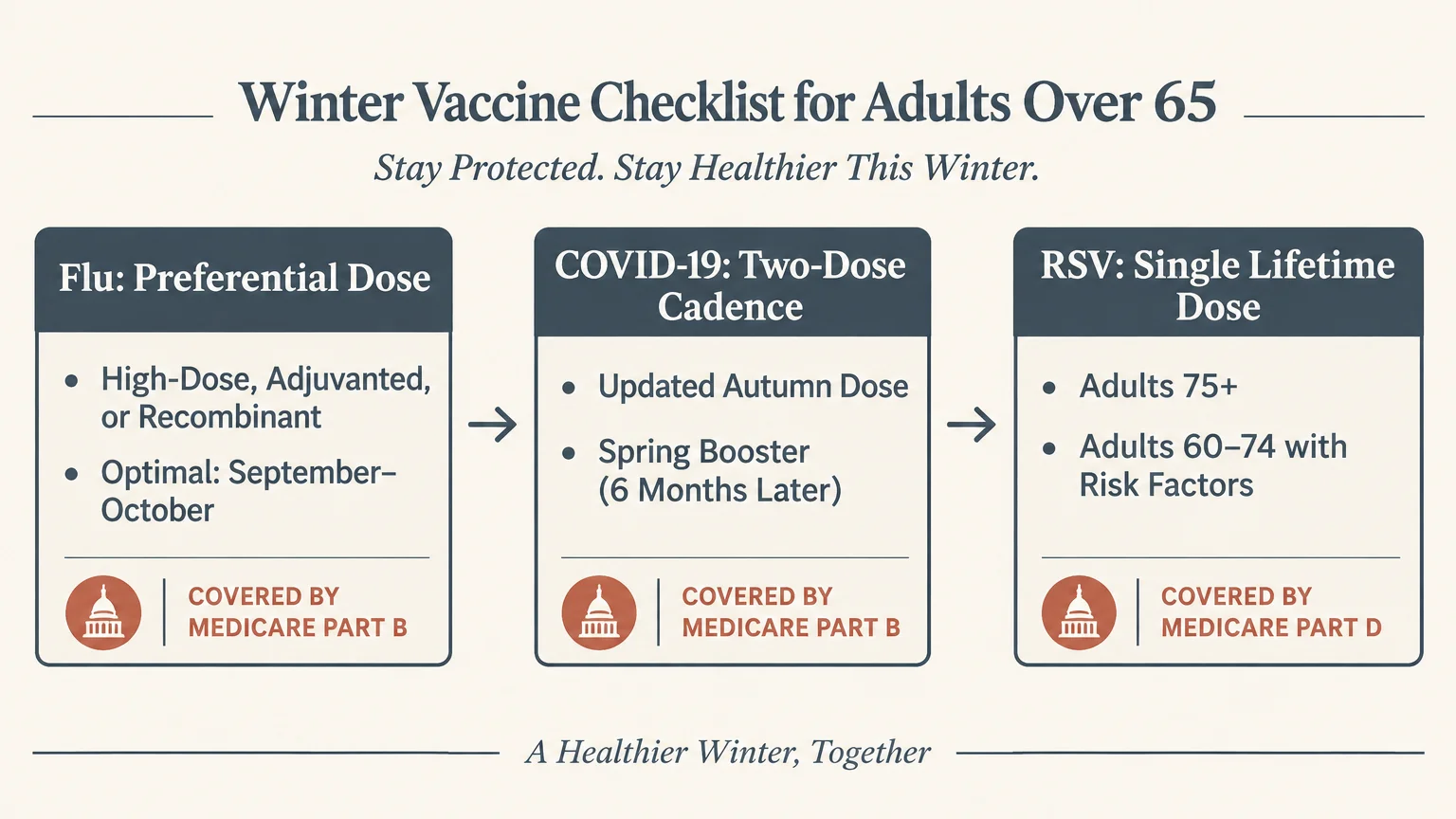
Protecting your lungs and independence after age 65 does not require memorizing complex medical charts. Focus on three clear actions this fall: verify your past RSV status, ask for an enhanced 2026–2027 flu shot, and schedule your two-part COVID-19 booster plan.
Book your RSV shot at an in-network pharmacy under Medicare Part D, and leverage Medicare Part B for $0 flu and COVID-19 protection. Taking these steady, evidence-based steps lets you enjoy family gatherings, holiday travel, and colder months with well-earned confidence.
This article is for informational purposes only and is not a substitute for professional medical advice, diagnosis, or treatment.