You spot flaky, cracked skin between your toes and reach for a thick foot cream. Yet days pass without relief, and the peeling edges slowly spread.
Dermatologists warn that persistent toe cracks often signal something very different from ordinary winter dryness. Treating the wrong culprit can trap moisture, fuel microbial growth, and spark painful complications.
Knowing how dry skin differs from foot fungus and lookalike rashes protects your mobility as you age. Here is what clinical evidence reveals about diagnosing and healing your feet.
Understanding Dry Skin on Feet and Why Aging Changes Your Barrier
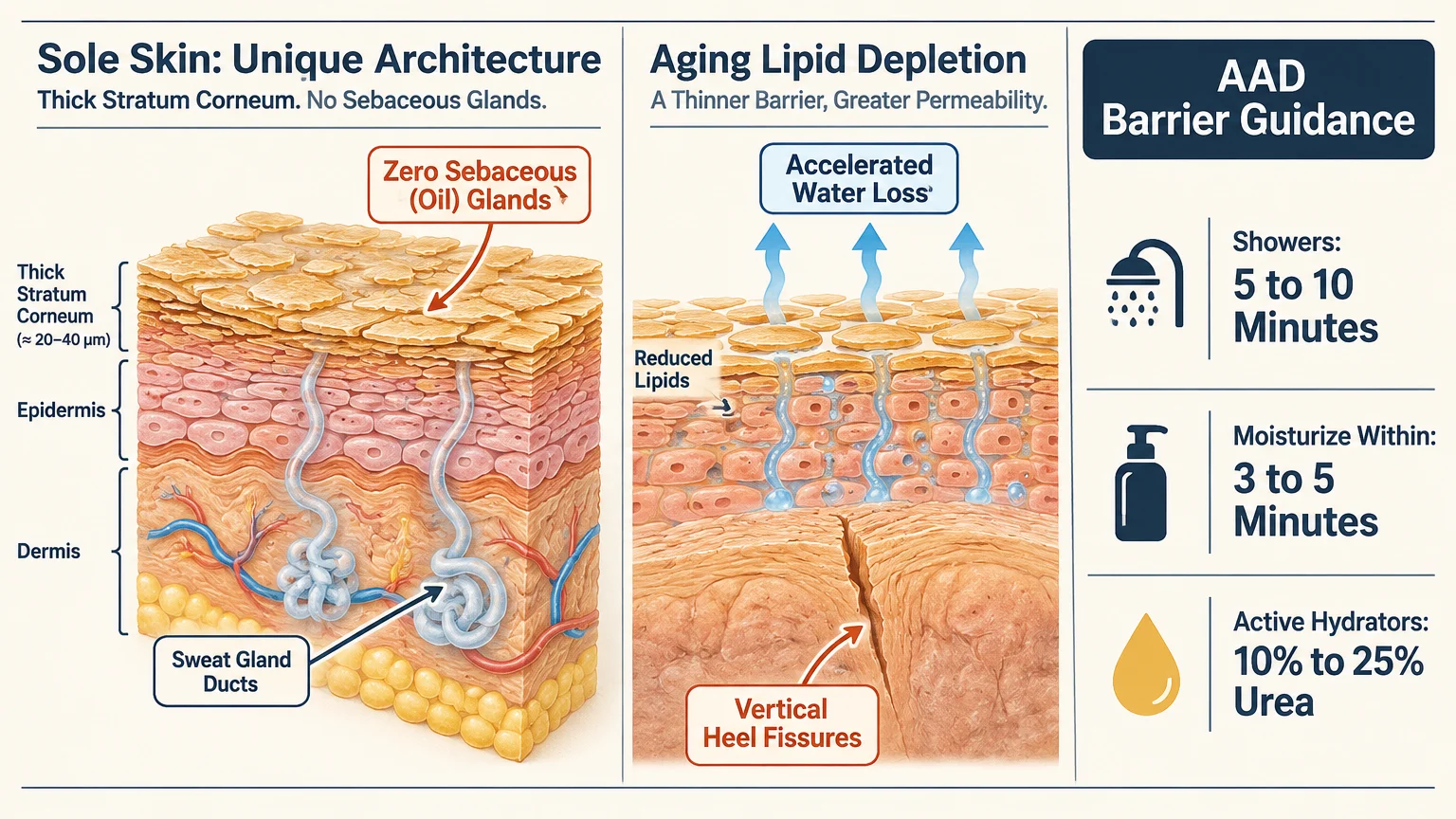
The skin on your feet faces relentless daily friction without the natural oil protection found elsewhere on your body. Your soles lack oil glands entirely, relying on sweat glands and a sturdy outer keratin layer to stay supple.
As you grow older, skin cell turnover slows and natural moisture-binding lipids gradually decline. That thinner lipid cushion lets water escape faster, leaving heels and outer foot edges rough, tight, and prone to splitting.
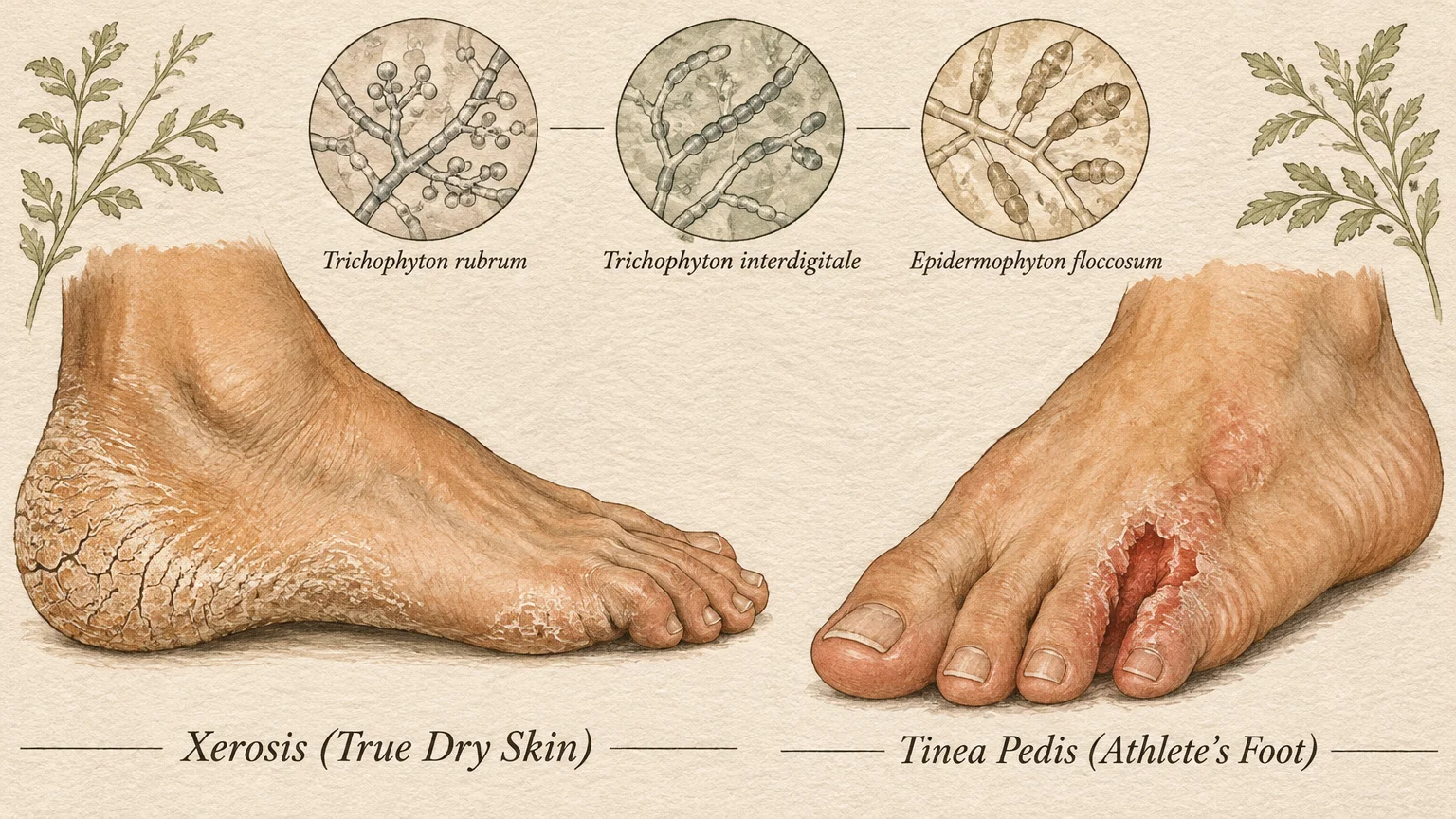
True dry skin on feet—known medically as xerosis—follows predictable patterns across weight-bearing zones. You usually see symmetrical flakiness, chalky scale, or vertical heel fissures rather than soggy peeling tucked tightly between your toes.
Everyday bathing habits often worsen age-related dryness without your realizing it. Long, steaming showers strip away the fragile surface lipids that keep foot skin flexible.
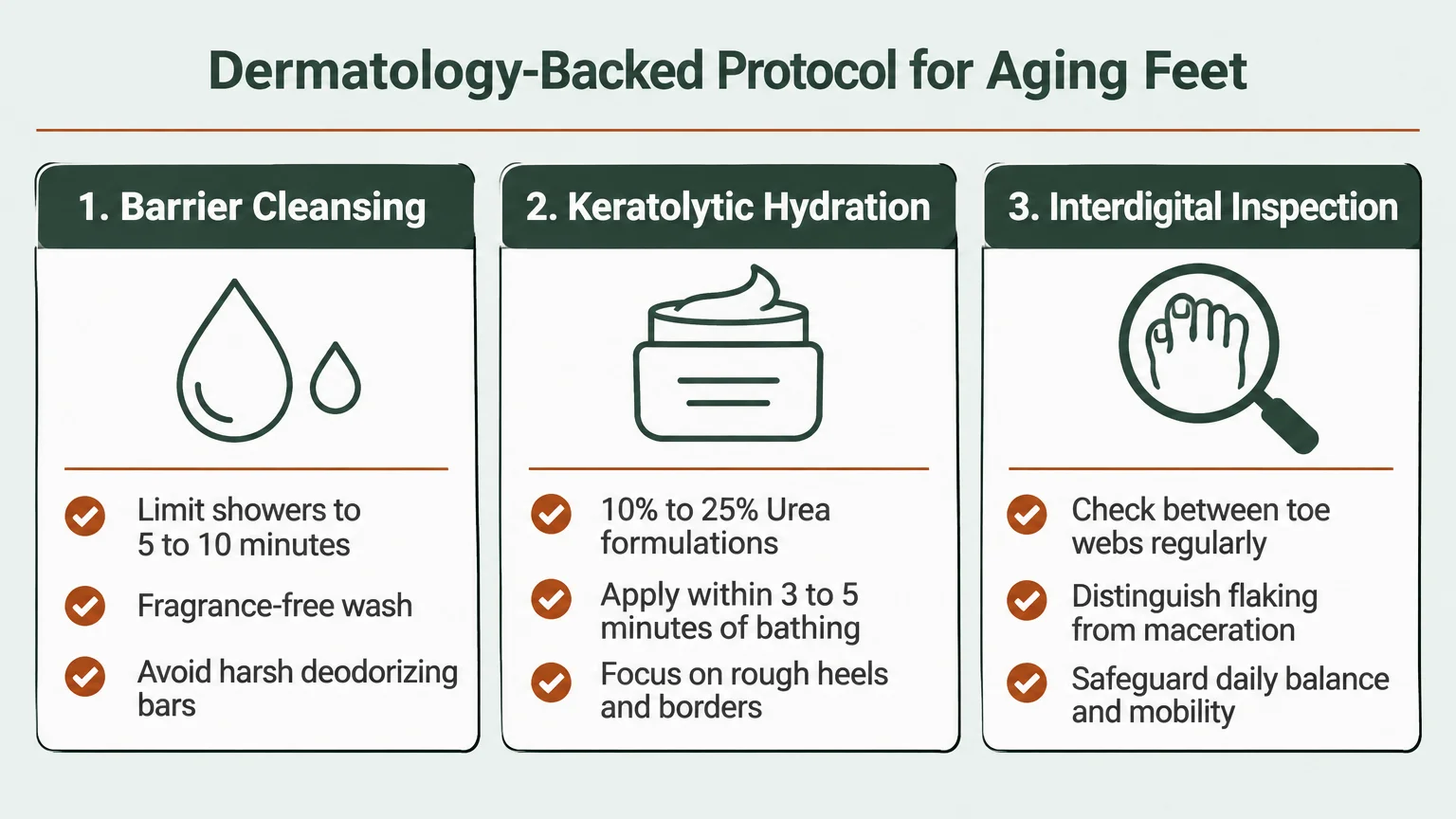
To prevent moisture loss, the American Academy of Dermatology (AAD) recommends limiting baths and showers to 5 to 10 minutes. Dermatologists also advise using gentle, fragrance-free cleansers rather than harsh deodorant soaps.
Timing your moisturizer matters just as much as the product inside the jar. According to AAD cracked-heel and dry-skin guidance, applying moisturizer within 3 to 5 minutes of bathing seals water inside damp skin.
Ingredient choice separates effective foot creams from basic body lotions that merely coat the surface. The AAD recommends creams containing 10% to 25% urea, alpha hydroxy acid, or salicylic acid to soften thick scale and draw hydration inward.
Yet heavy creams cannot fix every flaky toe problem. When peeling persists strictly between toes despite consistent moisturizing, an active skin infection—not simple dryness—often drives the irritation.
Understanding Foot Fungus and Athlete’s Foot Signs
When cracked, peeling toes refuse to heal with lotion, dermatologists frequently suspect athlete’s foot, or tinea pedis. This common infection develops when microscopic fungi called dermatophytes invade the outer layer of your skin.
Think of dermatophytes like tiny moths digesting the keratin proteins in your dead skin cells. According to NIH StatPearls, DermNet, and InformedHealth, three species cause most cases: Trichophyton rubrum, Trichophyton interdigitale, and Epidermophyton floccosum.
Although often dismissed as a locker-room nuisance, foot fungus affects people of all ages worldwide. A 2023 clinical review puts global point prevalence near 3%, while NIH StatPearls estimates about 10% of the total population is affected.
Other clinical sources report even broader reach across adulthood. Both the MSD Manual and systematic reviews indicate that 15% to 25% of people have athlete’s foot at any given time, and up to 70% experience it eventually.
Men develop tinea pedis more often than women, and peak incidence occurs between ages 16 and 45 according to a 2023 Drugs in Context review. Even so, older adults frequently contend with chronic, stubborn infections that linger unnoticed.
Recognizing classic athlete’s foot signs helps you spot trouble before cracks deepen. According to the MSD Manual and HealthCert, dermatologists classify the infection into four main patterns.
The interdigital type is the most familiar, usually starting in the tight space between your fourth and fifth toes. Warmth and trapped sweat turn the skin white, soggy, peeling, and painfully fissured.
The moccasin type behaves like an impostor, wrapping your soles and foot edges in chronic, silvery dryness. Because it rarely looks wet or inflamed, countless adults mistake moccasin-type foot fungus for harmless aging skin.
Less common forms look far more dramatic on inspection. The vesiculobullous type triggers itchy, fluid-filled blisters across your sole or instep, while the acute ulcerative type carves raw, eroded sores between toes.
The Surprising Connection: Why Cracked, Peeling Toes Mimic Dry Skin and Carry Hidden Risks
Treating cracked peeling toes by sight alone leads many well-meaning adults down the wrong path. A single misidentified patch can turn a minor cosmetic annoyance into a spreading rash or a serious medical emergency.
Moccasin Fungus and Visual Lookalikes
Even experienced clinicians know that eyes alone can deceive when examining peeling feet. The MSD Manual notes that clinical diagnosis by visual inspection has low accuracy because multiple skin disorders mimic athlete’s foot.
Several inflammatory and bacterial conditions closely copy fungal scaling and toe splits. Common lookalikes include dyshidrotic eczema, palmoplantar psoriasis, pitted keratolysis, and allergic shoe contact dermatitis.
Dyshidrotic eczema produces clusters of deep, itchy blisters on soles and toe edges that peel as they dry. Palmoplantar psoriasis creates thick, stubborn plaques that crack painfully under walking pressure.
Pitted keratolysis comes from bacteria rather than fungi, leaving tiny craters and strong odor on sweaty soles. Meanwhile, shoe contact dermatitis stems from allergic reactions to glues, dyes, or rubber inside footwear.
The AAD notes that more than 15,000 allergens can trigger contact dermatitis on human skin. Unlike athlete’s foot, however, shoe-related contact dermatitis often stays confined strictly to the tops of your feet.
To eliminate guesswork, dermatologists rely on fast office testing rather than assumptions. According to Mayo Clinic and a 2023 PMC review, clinicians scrape tiny flakes from the active rash border for microscopic or molecular analysis.
A potassium hydroxide (KOH) wet-mount exam acts like clearing fog off a windowpane so fungal threads stand out cleanly. Doctors can also order a fungal culture or rapid PCR test when initial scrapings look unclear.
The Steroid Cream Trap and Hidden Spread
When peeling skin itches or burns, reaching for an over-the-counter hydrocortisone cream feels instinctive. Yet the Centers for Disease Control and Prevention (CDC) explicitly warns against applying steroid creams to athlete’s foot or undiagnosed foot rashes.
Corticosteroids calm surface redness by temporarily muting your skin’s local immune defenses. Without those immune guards patrolling the area, keratin-eating fungi multiply faster and tunnel deeper across your foot.
Doctors call the resulting distorted rash tinea incognito because steroids erase the classic scaly border clues. What began as localized toe peeling can morph into a widespread, angry infection that puzzles future examiners.
Combination prescription creams carrying both an antifungal and a strong steroid pose extra hazards. In a January 2024 Morbidity and Mortality Weekly Report (MMWR), the CDC flagged clotrimazole-betamethasone for causing skin damage in folds and adrenal suppression with prolonged use.
From Broken Toes to Bacterial Cellulitis
A tiny crack between your toes may seem trivial until bacteria find it. Healthy skin works like a sealed brick wall, keeping surface microbes harmlessly outside your bloodstream.
Once fungal maceration splits the toe web, Streptococcus and Staphylococcus bacteria gain a direct entry route into deeper tissue. Clinical research cited by the AAD, StatPearls, and HMP Global Learning Network shows athlete’s foot triples the risk of nonpurulent leg cellulitis.
Cellulitis triggers spreading redness, warmth, swelling, and tenderness up your foot and lower leg, often requiring prompt antibiotics. Addressing mild toe-web peeling early removes that bacterial doorway before systemic infection takes hold.
Adults managing diabetes face sharply elevated stakes from small foot fissures. Because diabetic nerve damage dulls pain signals, deep cracks and ulcers can worsen silently without triggering warning discomfort.
In May 2024 diabetes guidance, the CDC advises inspecting your feet daily for redness, cuts, or peeling. Wash feet in warm rather than hot water without soaking, and never apply lotion between your toes where trapped moisture breeds infection.
Emerging Drug-Resistant Fungi in the United States
Stubborn foot fungus is also evolving in ways that make accurate diagnosis more urgent than ever. Public health officials now track emerging dermatophyte strains that shrug off standard first-line pills and creams.
In an October 13, 2026 clinician brief, the CDC highlighted three emerging dermatophytes reported in the United States. These include Trichophyton indotineae, terbinafine-resistant Trichophyton rubrum, and sexually transmitted Trichophyton mentagrophytes genotype VII (TMVII).
According to CDC MMWR reports, T. indotineae was first identified in the United States in May 2023. By January 2024, antimicrobial-resistant dermatophytosis had surfaced in at least 11 U.S. states.
Resistance rates inside tracked clusters underscore why failed treatments deserve professional evaluation. In a 2022–2024 New York dataset published in April 2026, 57% of T. indotineae isolates resisted terbinafine, while 38% to 52% showed reduced azole susceptibility.
What This Means for Your Health and Treatment Choices
Understanding the biology behind cracked toes transforms how you respond at the pharmacy aisle. Once you confirm dry skin versus fungal infection, matching your treatment saves weeks of wasted effort and shields nearby nails.
If your dermatologist or doctor confirms athlete’s foot, targeted non-prescription antifungals remain the first-line choice for most mild cases. The CDC notes that over-the-counter creams, ointments, lotions, or powders—including clotrimazole, miconazole, terbinafine, and ketoconazole—typically require 2 to 4 weeks of steady use.
Stopping treatment the moment flaking disappears is one of the most common reasons rashes rebound. Mayo Clinic recommends applying over-the-counter antifungals twice daily and continuing for 1 full week after visible skin clears.
Coverage technique also shapes whether microscopic spores survive around the edges. Clinical guidance advises spreading antifungal cream roughly 2 centimeters—about 1 inch—beyond the visible rash border to catch advancing fungal threads.
Not all over-the-counter formulas clear fungi at identical speeds or prices. Clinical trials summarized by NIH/PMC and the BMJ reveal useful trade-offs when choosing between common pharmacy tubes.
An 8-week randomized trial of 429 patients found that 1% terbinafine applied twice daily for 1 week matched 4 weeks of 1% clotrimazole. Effective treatment reached 83% versus 82%, while per-protocol mycological cure hit 95% versus 91%.
An earlier 256-patient BMJ trial reported 93.5% mycological cure at week 4 for terbinafine compared with 73.1% for clotrimazole. A systematic review in NIH/PMC likewise reports a 72% clinical cure rate for topical terbinafine versus 28% for placebo, with a number needed to treat of 3.
Budget considerations may guide your decision if you expect a longer course. According to an NIH/PMC clinical review, a typical 30-gram U.S. tube costs roughly $13 for 1% clotrimazole, $15 for 2% miconazole, and $30 for 1% terbinafine.
Many older adults ask whether natural essential oils can replace pharmacy antifungals for peeling toes. In a 4-week randomized trial of 71 participants cited by NIH/PMC, tea tree oil performed no differently than placebo—and essential oils frequently irritate cracked skin.
Sometimes topical creams alone cannot penetrate thick scale or nail plates. According to the MSD Manual and a 2023 PMC review, physicians reserve oral antifungal pills for severe, moccasin-type, or resistant infections, immunocompromised patients, or coexisting toenail fungus.
Mayo Clinic lists typical adult oral terbinafine dosing for tinea pedis at 250 mg once daily for 2 to 6 weeks. If fungi invade your toenails, clearing nail infections can take several months to 1 year according to the CDC.
Knowing when to pause self-care protects your legs and overall health. Mayo Clinic and the American Podiatric Medical Association advise seeing a doctor or podiatrist if a foot rash shows no improvement after 2 weeks of over-the-counter treatment.
Seek medical attention promptly—without waiting 2 weeks—if you spot swelling, pus, spreading warmth, or fever. Anyone living with diabetes should also have new foot cracks evaluated quickly by a healthcare professional.
Proactive Measures: Dermatologist Foot Care You Can Start Today
Consistent dermatologist foot care works both ways—it heals fragile aging skin barriers and deprives fungal spores of the damp warmth they crave. Small daily adjustments keep your feet comfortable year-round.
Smart Bathing and Targeted Moisturizing
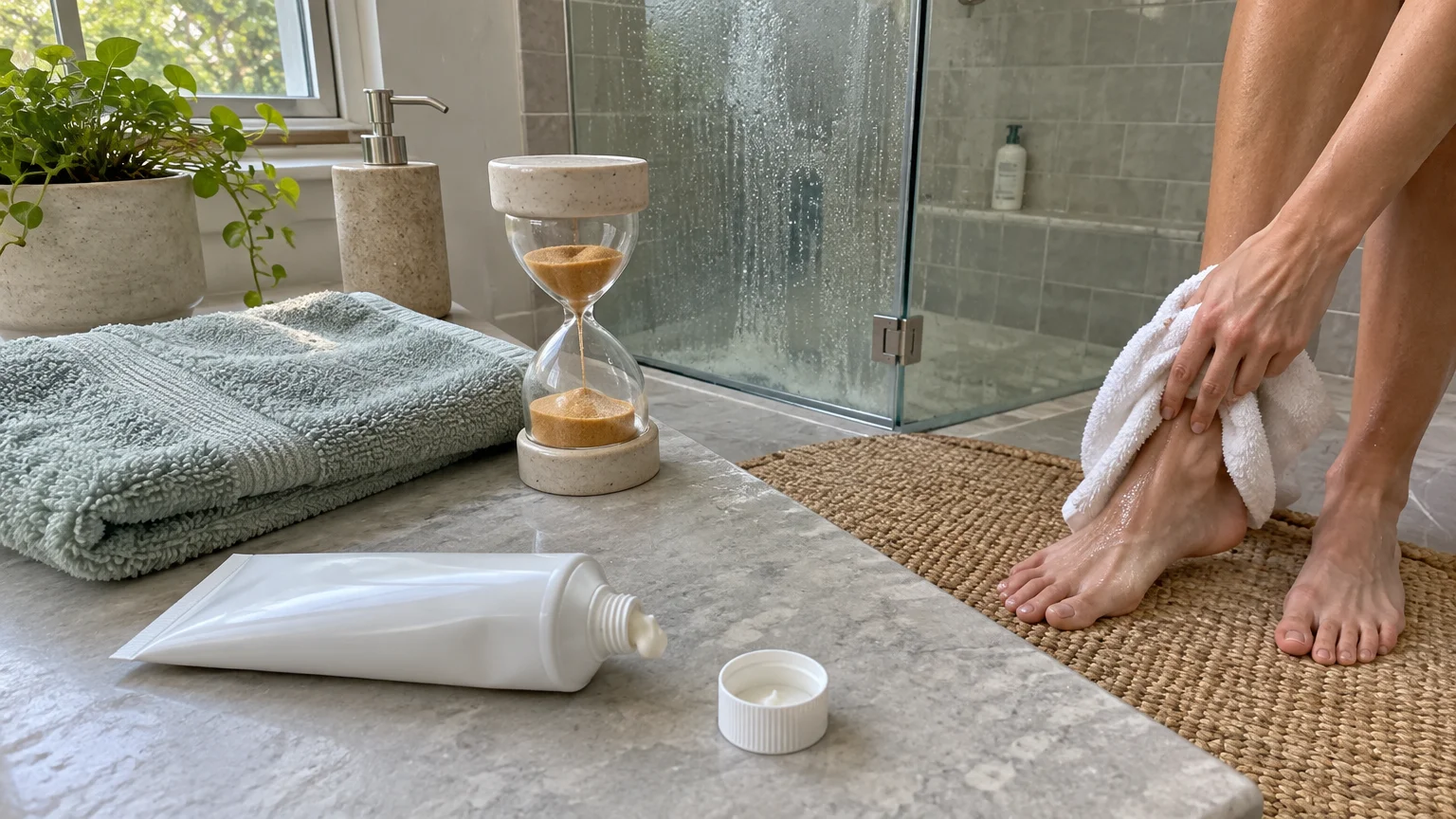
Keep showers between 5 and 10 minutes using lukewarm water and a gentle, fragrance-free cleanser as recommended by the AAD. Immediately afterward, pat your feet thoroughly dry with a clean towel, paying close attention to the spaces between every toe.
For rough soles and cracked heels without signs of toe-web fungus, apply a cream containing 10% to 25% urea, alpha hydroxy acid, or salicylic acid within 3 to 5 minutes of bathing. That brief damp window locks water deep inside thickened outer skin.
When heel fissures split during the day, the AAD suggests sealing clean cracks with a liquid bandage to keep out dirt and bacteria. At bedtime, layering plain petroleum jelly beneath soft cotton socks boosts overnight barrier repair.
If you have diabetes, follow the CDC rule strictly by moisturizing only the tops and bottoms of your feet. Keep creams and ointments completely out of toe spaces so excess moisture never softens fragile interdigital skin.
Footwear, Laundry, and Bathroom Hygiene
Fungal spores linger effortlessly inside damp textiles, gym mats, and shower tiles, waiting to reinfect freshly treated toes. Smart household habits break that cycle before symptoms return.
InformedHealth.org recommends washing socks and foot towels at 60°C (140°F) or higher to destroy resilient fungal spores. To disinfect contaminated shower floors or tub surfaces, the CDC notes that strong detergents or diluted chlorine bleach—1/4 cup per gallon of water—kill ringworm fungi.
Moisture management inside your shoes matters every single morning. Choose breathable, moisture-wicking socks, change them at least once daily—or immediately after sweating—and rotate shoes day-to-day so each pair dries fully between wearings.
Protect bare feet whenever you walk across shared damp floors at pools, hotel rooms, or gym locker rooms. Slipping on waterproof sandals or flip-flops creates a simple barrier against dermatophytes left behind by others.
Finally, adopt a clever dressing sequence recommended by physicians in HMP treatment guidance. Put your socks on before your underwear each morning so fungal flakes from your feet never transfer upward to cause groin ringworm.
The Future of Dermatophyte Research
Medical researchers and public health networks are actively refining how clinicians detect and treat stubborn foot infections. Faster laboratory tools aim to end months of trial-and-error guessing for patients with chronic scaling.
Traditional potassium hydroxide microscopy and multi-week fungal cultures remain valuable, yet molecular PCR assays are playing a growing role in confirming exact fungal species quickly. Earlier species identification helps doctors distinguish routine infections from resistant strains before prescribing months of medication.
At the same time, CDC surveillance programs and state health laboratories continue tracking how Trichophyton indotineae, terbinafine-resistant T. rubrum, and TMVII spread across U.S. communities. Public health updates emphasize antifungal stewardship—testing rashes early and avoiding inappropriate steroid combinations—to keep existing therapies effective for aging adults.
Frequently Asked Questions About Cracked, Peeling Toes
Can ordinary dry skin cause cracks strictly between my toes?
Ordinary dry skin usually affects your heels, outer soles, and tops of feet rather than staying confined between toes. Soggy, white, or peeling fissures between the fourth and fifth toes most commonly point to interdigital athlete’s foot.
Why did my toe rash get worse after I applied hydrocortisone cream?
Hydrocortisone suppresses local skin immunity, allowing hidden dermatophyte fungi to multiply rapidly and spread beyond their original border. The CDC advises against using steroid creams on undiagnosed foot rashes because they trigger harder-to-identify tinea incognito.
How long should I keep using over-the-counter antifungal cream?
Most over-the-counter antifungal creams require twice-daily application for 2 to 4 weeks, continuing 1 week after the skin looks clear. Always spread medication roughly 2 centimeters beyond the rash border.
Does athlete’s foot really raise my risk of a serious leg infection?
Yes—clinical research shows tinea pedis triples the risk of nonpurulent leg cellulitis. Open fissures between your toes let Streptococcus and Staphylococcus bacteria bypass your skin barrier and enter deeper tissue.
Should I soak my feet in hot water or use tea tree oil to heal cracked toes?
Dermatologists advise skipping both remedies for peeling or cracked toes. Hot soaks strip protective lipids—and pose burn risks for diabetic feet—while a 4-week clinical trial found tea tree oil no more effective than placebo.
Protecting Your Feet as You Age
Healthy, pain-free feet quietly anchor your balance, daily walks, and independence throughout older adulthood. Paying closer attention to subtle peeling or splits between your toes helps you catch small problems while they remain easy to solve.
Instead of assuming every flaky patch is simple dryness—or masking irritation with leftover steroid creams—let the location and persistence of your symptoms guide your next step. Pair smart daily hygiene with prompt clinical testing whenever over-the-counter care stalls after 2 weeks.
This article is for informational purposes only and is not a substitute for professional medical advice, diagnosis, or treatment.