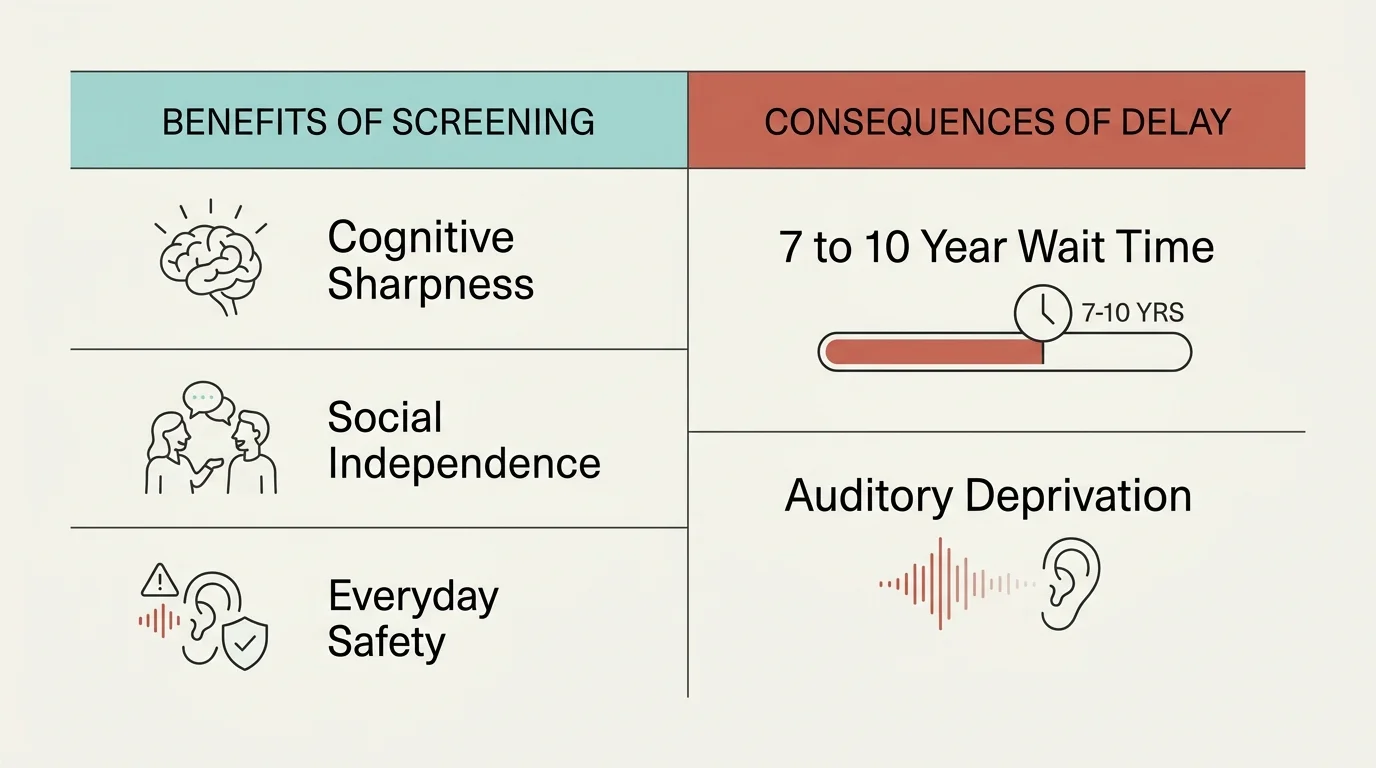
Adding a hearing screening to your annual wellness exam preserves your cognitive sharpness, social independence, and everyday safety. While standard medical checkups routinely track blood pressure and cholesterol, auditory health often falls through the cracks until significant damage occurs. Because age-related hearing loss develops gradually, you might not notice how much sound you miss each day. Scheduling a routine hearing test allows your doctor to detect subtle auditory changes early, protect brain function, and connect you with effective modern solutions before communication struggles strain your daily relationships.
Understanding Age-Related Hearing Changes and Why Routine Screening Matters
Age-related hearing loss, clinically known as presbycusis, occurs when the microscopic sensory hair cells inside your inner ear gradually break down over time. These delicate cells convert sound vibrations into electrical signals for your brain to interpret; once they suffer damage, your auditory system cannot regenerate them. Data from the Centers for Disease Control and Prevention and the National Institutes of Health show that hearing loss ranks as the third most common chronic physical condition affecting older adults, trailing only arthritis and hypertension.
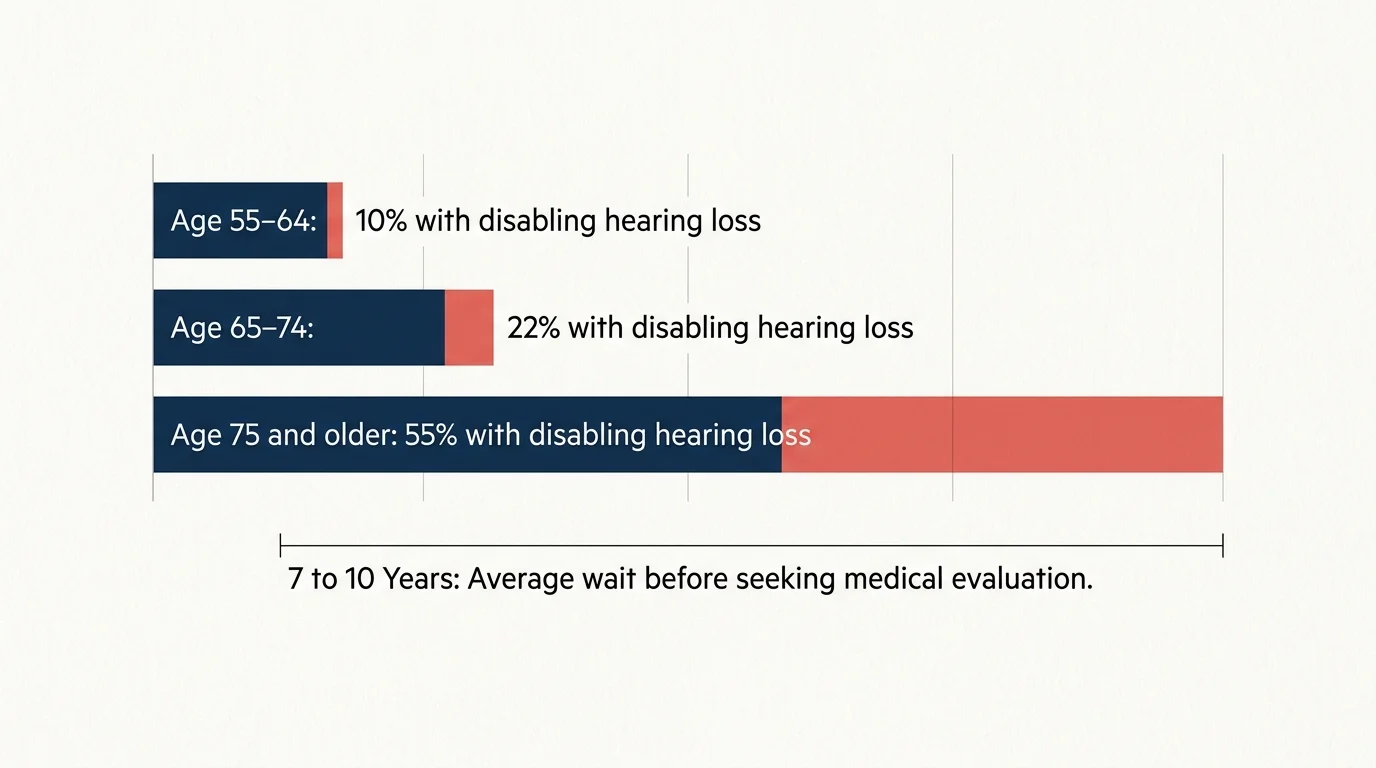
Approximately 37.5 million American adults report some degree of hearing difficulty. The prevalence rises sharply with age: roughly 10% of adults aged 55 to 64 live with disabling hearing loss, increasing to 22% among those aged 65 to 74, and exceeding 55% for individuals aged 75 and older. Despite these staggering numbers, adults wait an average of seven to ten years between first noticing auditory changes and seeking medical evaluation. Furthermore, fewer than one in five people who could benefit from hearing aids actually wear them.
Most annual physicals do not automatically include an audiometric screening. Primary care physicians often assume you will bring up auditory challenges voluntarily, while you might assume your doctor will test your hearing if necessary. Requesting an annual physical hearing screening closes this communication gap, establishing an accurate baseline to protect your health before serious auditory deprivation occurs.
9 Signs Your Annual Exam Should Include a Hearing Test
Recognizing the subtle warning signs of auditory decline empowers you to advocate for your health during your yearly checkup. If you experience one or more of the following scenarios, ask your doctor for a formal hearing evaluation.
1. You Frequently Ask Others to Repeat Themselves or Accuse People of Mumbling
Presbycusis typically damages high-frequency hearing first, making it hard to distinguish high-pitched consonant sounds such as “s,” “f,” “th,” and “sh.” As a result, speech sounds loud enough, but words lose their clarity. You may perceive that younger family members, women, or service workers are mumbling when your ears are simply missing the critical consonant frequencies that define clear speech.
2. Background Noise Turns Group Conversations into White Noise
In quiet settings, you might follow a conversation with ease; however, bustling restaurants, family parties, or noisy waiting rooms turn group dialogue into chaotic background noise. Audiologists refer to this as the “cocktail party effect.” When hearing loss begins, your brain loses its ability to filter out ambient sound waves, forcing you to strain to isolate the voice directly in front of you.
3. The Television Volume Creeps Up to Uncomfortable Levels for Others
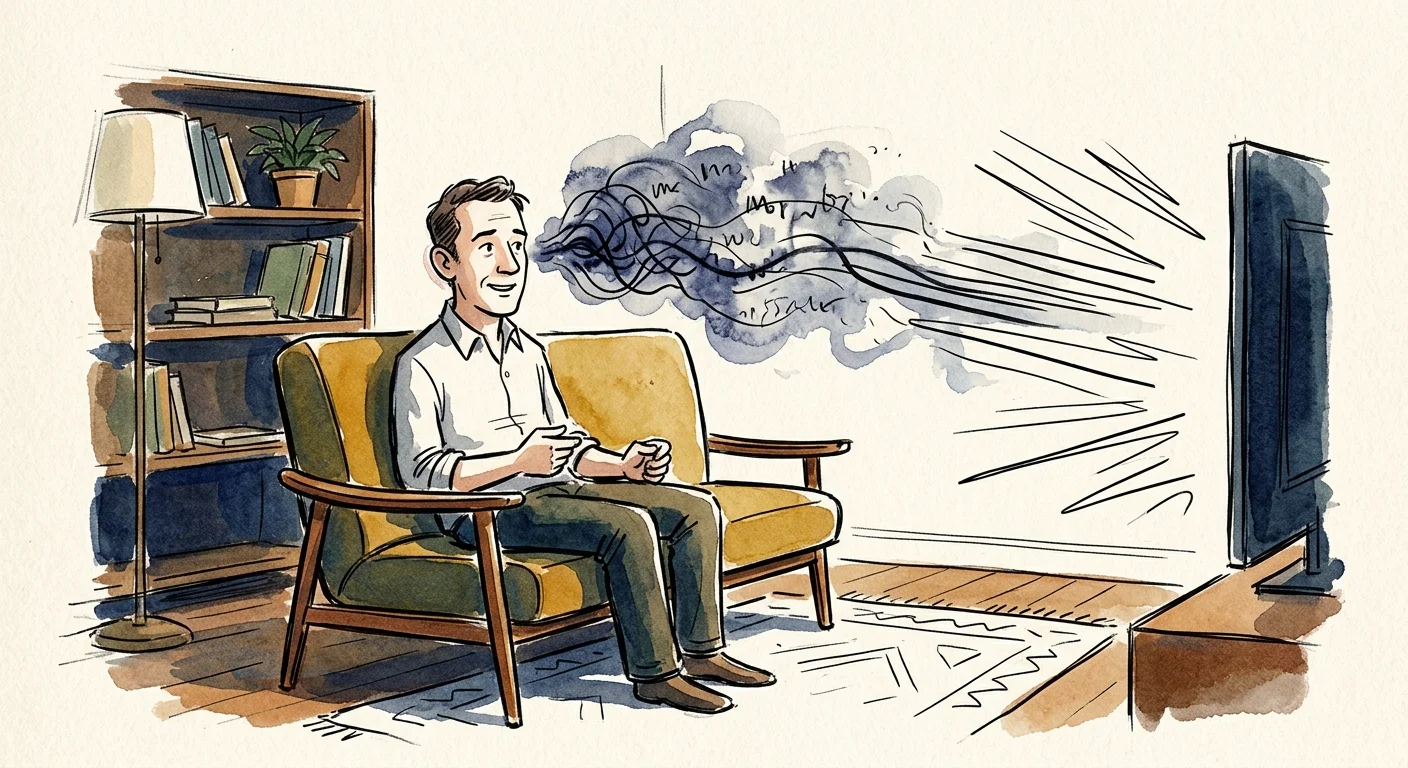
Needing to increase the television or radio volume higher than other family members prefer is a classic sign of progressive auditory changes. You might find yourself turning up the dial to hear dialogue during movies, only for background music and explosions to become jarringly loud. Raising the volume compensates for lost clarity, but it cannot replace missing sound frequencies.
4. You Subconsciously Rely on Lip-Reading to Understand Speech
Many adults unconsciously adapt to hearing loss by watching a speaker’s lips, facial expressions, and body language to fill in missing acoustic cues. If you find it much harder to understand someone when they turn their back, look down at a menu, or speak from another room, your visual system is working overtime to compensate for auditory deficits.
5. Phone Calls Feel Strenuous, Unclear, or Frustrating
Telephone conversations strip away all visual cues, relying entirely on your ears to process compressed audio signals through a small speaker. If you constantly switch the phone from ear to ear, max out the earpiece volume, or avoid making calls because you worry about misunderstanding the person on the other end, your ears need a clinical assessment.
6. Persistent Ringing, Buzzing, or Hissing Sounds Echo in Your Ears
Tinnitus—the perception of internal ringing, whistling, clicking, or roaring sounds—frequently accompanies age-related hearing changes. When sensory hair cells in the cochlea sustain damage, the auditory cortex in your brain can generate phantom sounds to fill the acoustic silence. If ringing interferes with your sleep or quiet relaxation, discuss it at your annual exam.
7. Social Gatherings Leave You Mentally and Physically Exhausted
Listening should not feel like an aerobic workout. When your ears fail to deliver complete acoustic signals, your brain must redirect precious cognitive energy toward decoding fragmented words through context clues. This heightened mental effort causes intense listening fatigue, often leading older adults to leave social events early or feel completely drained after a simple dinner with friends.
8. Loved Ones Point Out That You Miss Everyday Environmental Sounds
Hearing loss develops so gradually that family members often notice your symptoms long before you do. You might miss high-pitched environmental signals such as the microwave timer, the car’s turn signal clicker, the doorbell, or singing birds outdoors. If friends or relatives consistently mention sounds you fail to notice, take their observations seriously and request a test.
9. You Notice Subtle Balance Changes or Feel Unsteady on Your Feet
Your inner ear houses both the cochlea, which manages hearing, and the vestibular system, which controls balance and spatial orientation. Because these structures share fluid chambers and nerve pathways, age-related changes in the ear can simultaneously compromise both senses. Hearing loss also increases your cognitive load, leaving fewer mental resources available to maintain steady posture and avoid tripping hazards.

Key Considerations for Older Adults
Untreated hearing loss extends far beyond simple communication inconveniences; it profoundly influences overall systemic and neurological health. A landmark report from the Lancet Commission on Dementia Prevention identified midlife and late-life hearing loss as the single largest modifiable risk factor for dementia. Untreated mild, moderate, and severe hearing loss correlate with a twofold, threefold, and fivefold increase in dementia risk, respectively.
The ground-breaking ACHIEVE randomized clinical trial, published in The Lancet in July 2023, confirmed this crucial connection. Researchers found that older adults with increased risk for cognitive decline who received hearing aids and audiological counseling reduced their rate of cognitive decline by 48% over a three-year period. By ensuring your brain receives a full spectrum of acoustic stimulation, you help preserve vital neural pathways responsible for memory and executive function.
Hearing impairment also triggers significant psychosocial consequences. When following conversations becomes exhausting or embarrassing, many seniors withdraw from community activities, faith groups, and family gatherings. This self-imposed isolation accelerates loneliness and depression, two conditions that directly worsen cardiovascular health and physical vitality. Maintaining auditory wellness helps you preserve your independence, emotional resilience, and connection to your loved ones.
Benefits and Potential Risks of Routine Screening
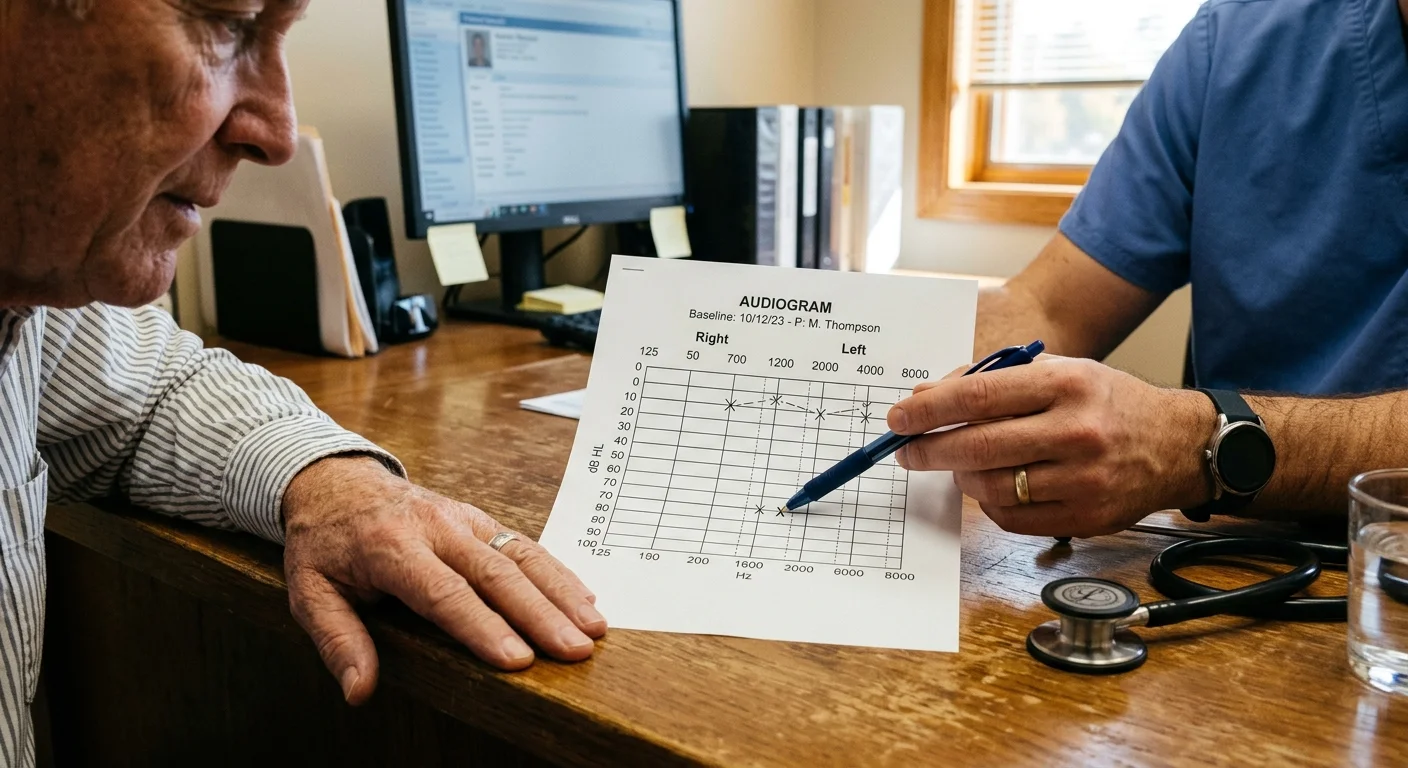
Incorporating a hearing test into your yearly physical offers substantial advantages with minimal clinical burden. A comprehensive audiogram maps your unique hearing profile, pinpointing the precise decibel thresholds and frequencies where sound begins to fade. Early detection allows you to address subtle hearing loss before your brain’s auditory processing centers adapt to prolonged silence, making future transitions to corrective devices smoother and more successful.
Early screening also helps identify easily reversible conditions. Primary care doctors frequently discover that sudden hearing muffledness stems from impacted cerumen (earwax) or middle ear fluid rather than permanent nerve damage. Clearing an ear canal obstruction can instantly restore your baseline hearing without the need for expensive interventions.
The primary risks surrounding hearing health involve diagnostic delays and unguided self-treatment. Waiting years to address noticeable hearing loss forces your auditory cortex to undergo structural reorganization, which makes adapting to amplified sound much harder later on. Conversely, purchasing unverified direct-to-consumer sound amplifiers without an accurate professional diagnosis can over-amplify harsh noise, potentially causing additional acoustic trauma. Professional screening ensures you receive the correct diagnostic insight for your specific clinical needs.
What the Clinical Experts and Guidelines Recommend
Leading audiological and medical organizations emphasize proactive screening throughout the aging process. The American Speech-Language-Hearing Association recommends that all adults undergo an audiologic screening at least once every ten years up to age 50, and every three years thereafter. For individuals experiencing persistent symptoms, noise exposure history, or cognitive concerns, annual evaluations provide the safest standard of care.
Global health authorities, including the World Health Organization, stress that regular ear checks should form an integral component of healthy aging protocols worldwide. Medical experts at the Mayo Clinic encourage adults to track their hearing health just as diligently as they monitor vision, blood pressure, and bone density.
Regulatory frameworks have modernized rapidly to expand public access to hearing healthcare. In October 2022, the Food and Drug Administration enacted a landmark rule establishing an over-the-counter (OTC) hearing aid category. This regulation enables adults aged 18 and older with perceived mild-to-moderate hearing impairment to purchase high-quality hearing technology directly from pharmacies and retailers without a prescription. Furthermore, in September 2024, the FDA authorized the first over-the-counter hearing aid software feature for mainstream consumer earbuds, allowing individuals to screen their hearing at home and apply custom sound amplification directly through personal devices.
Practical Steps to Advocate for Your Auditory Health
When preparing for your next annual wellness exam, prepare a list of specific acoustic environments where you struggle to hear. Tell your primary care provider directly: “I want to include an annual physical hearing screening in my exam today because I have noticed changes in background noise clarity.” Clear, proactive communication ensures your physician allocates adequate time for this vital check.
Ask your primary care physician to perform an otoscopic exam to check for earwax accumulation, eardrum abnormalities, or infection. While simple office screenings—such as whispered voice tests or questionnaires—offer a useful snapshot, ask for a formal referral to a licensed audiologist for a comprehensive diagnostic pure-tone and speech audiometry evaluation.
When you meet with an audiologist, discuss your daily lifestyle demands, hobbies, and communication priorities. If your test reveals mild-to-moderate hearing loss, explore whether FDA-cleared over-the-counter devices or custom-programmed prescription hearing aids best suit your auditory needs and manual dexterity. Taking early ownership of your hearing care ensures you remain fully engaged in every area of life.
Frequently Asked Questions About Hearing Tests and Screenings
Does original Medicare cover annual routine hearing tests?
Original Medicare Part B covers diagnostic hearing exams only when your primary care physician or specialist orders the test to evaluate a specific medical complaint, such as sudden hearing loss, trauma, or balance disorders. Medicare does not cover routine annual screenings or standard hearing aids. However, many Medicare Advantage (Part C) plans offer supplemental benefits that include routine screenings, hearing aid allowances, and discounted fitting services.
What is the difference between a hearing screening and a diagnostic evaluation?
A hearing screening is a quick pass-fail assessment designed to indicate whether you have hearing loss within normal conversational ranges. A comprehensive diagnostic audiological evaluation, conducted by an audiologist, measures your exact hearing thresholds across multiple frequencies in each ear, assesses your speech recognition in quiet and noisy environments, and evaluates middle-ear function.
Can over-the-counter hearing aids replace a visit to an audiologist?
Over-the-counter hearing aids offer an accessible, affordable option for adults with self-perceived mild-to-moderate hearing loss. However, they do not replace a comprehensive medical examination. A licensed audiologist or ear, nose, and throat (ENT) physician can identify underlying medical conditions—such as acoustic neuromas, otosclerosis, or severe asymmetric loss—that OTC devices cannot properly address.
How quickly does age-related hearing loss progress?
Presbycusis progresses slowly and symmetrically across both ears over several years or decades. Because the rate of decline is gradual, your brain adapts to diminished sound input, masking the true extent of the impairment. Sudden hearing loss occurring over hours or days is a medical emergency that requires immediate evaluation by an ENT specialist to prevent permanent damage.
Why can I hear someone speaking but fail to understand what they are saying?
This common issue occurs because age-related hearing loss disproportionately damages the cochlear hair cells responsible for high-frequency sounds. Vowel sounds occupy low frequencies and provide speech volume, while consonant sounds occupy high frequencies and provide clarity. When you lose high frequencies, you hear the volume of the voice but cannot distinguish the distinct consonants that make words intelligible.
Prioritizing Your Hearing for Lifelong Health
Your auditory system plays a foundational role in maintaining cognitive sharpness, emotional well-being, and vibrant relationships throughout your senior years. Requesting an annual exam hearing test inclusion is a proactive health decision that protects your brain, prevents unnecessary social withdrawal, and keeps you safely oriented to your environment. Speak with your healthcare provider at your next annual visit, explore modern hearing solutions, and preserve the everyday sounds that enrich your life.
This article is intended for informational and educational purposes only and is not a substitute for professional medical advice, diagnosis, or treatment. Always consult with a qualified healthcare provider regarding any health concerns or before making any decisions related to your health or treatment.